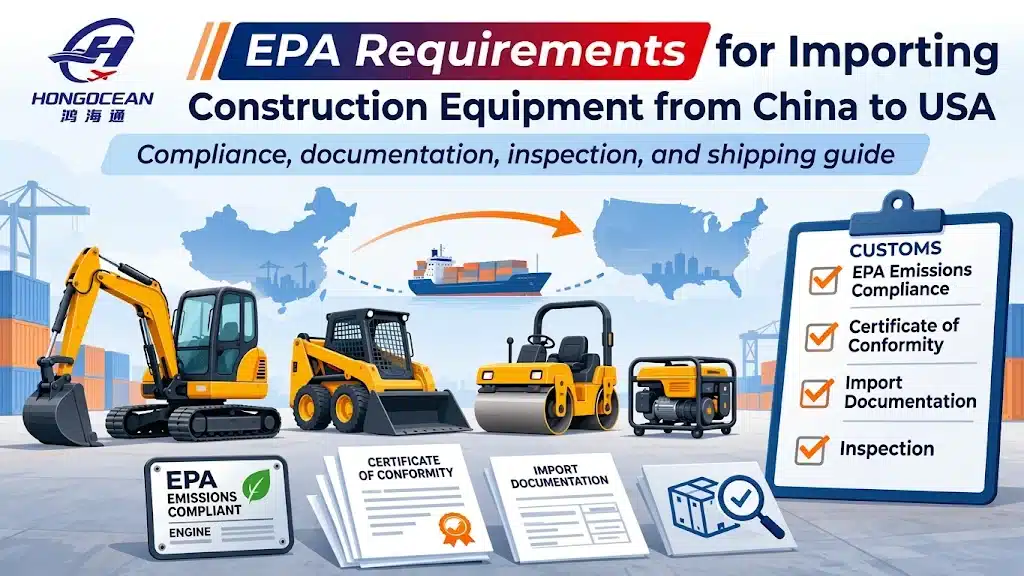
Importing construction equipment from China to the USA can be a good way to reduce purchasing costs and expand your equipment supply options. However, before shipping excavators, wheel loaders, bulldozers, or other heavy machinery, you need to understand the U.S. Environmental Protection Agency (EPA) requirements.
Unlike ordinary commercial goods, construction equipment with internal combustion engines may need to meet specific emissions standards before entering the United States.
You also need to prepare the correct EPA documents, customs declarations, and shipping arrangements. If any of these requirements are overlooked, your equipment may face additional inspections, customs delays, or even import restrictions.
So, what do you need to prepare before importing construction equipment from China to the USA?
In this guide, we will explain the main EPA requirements, import documents, customs procedures, shipping methods, and costs involved. Whether you are importing a new excavator or purchasing used construction machinery, this information will help you plan your shipment.
What Construction Equipment Can You Import from China to the USA?
China is one of the major manufacturing markets for construction machinery. Many American importers purchase heavy equipment from Chinese manufacturers because of the available product options and competitive factory prices.
Common construction equipment imported from China includes:
- Excavators and mini excavators
- Wheel loaders and skid steer loaders
- Bulldozers and crawler tractors
- Motor graders
- Road rollers and soil compactors
- Construction cranes
- Diesel-powered industrial machinery
However, before placing an order, you should check whether the equipment is subject to EPA emissions regulations.
The important thing is not simply where the machine was manufactured. The engine type, rated power, model year, and intended use all affect the applicable requirements.
EPA Requirements for Diesel Construction Equipment
Most conventional construction machinery uses diesel engines.
These engines are generally regulated under the EPA nonroad compression-ignition engine regulations in 40 CFR Part 1039, depending on their category and specifications.
The applicable emissions standard may depend on:
- Engine power rating in kilowatts (kW)
- Engine manufacturer and model
- Production year
- Engine family
- Equipment classification
- Whether the equipment is new or used
For example, if you are importing a diesel excavator from China, you should ask your supplier for the engine specifications and applicable EPA certification information before arranging transportation.
Do not assume that every machine must meet Tier 4 Final. The applicable emissions standard depends on the specific engine category and regulatory requirements.
What About Gasoline-Powered and Electric Equipment?
Not all construction equipment uses diesel engines.
Some compact machinery uses gasoline engines, which may be subject to different EPA regulations, including 40 CFR Part 1048 or Part 1054, depending on the engine category.
Electric construction equipment without an internal combustion engine generally does not require nonroad engine emissions certification. However, other product and import requirements may still apply.
If you are unsure which regulations apply to your machinery, confirm the engine classification before purchasing.
Off-Road Equipment vs. Highway Vehicles
Another important point is the difference between off-road construction machinery and highway vehicles.
For example:
- Tracked excavators are generally classified as nonroad equipment.
- Wheel loaders are generally treated as nonroad machinery.
- Road-legal heavy-duty dump trucks may fall under highway vehicle regulations.
- Off-highway dump trucks require a separate classification assessment.
This distinction matters because different engine categories follow different EPA requirements.
What EPA Emission Standards Apply to Construction Equipment?
The EPA has established several emissions standards for nonroad diesel engines.
These standards are commonly known as Tier 1, Tier 2, Tier 3, and Tier 4.
If you are purchasing construction equipment from China, you should understand which standard applies to the specific engine you plan to import.
Understanding EPA Tier 1 to Tier 4 Standards
Generally, the Tier standards represent different stages of emissions control requirements.
| EPA Standard | General Description |
|---|---|
| Tier 1 | Earlier nonroad engine emissions standards |
| Tier 2 | More restrictive emissions limits |
| Tier 3 | Further reductions in regulated exhaust emissions |
| Tier 4 Interim | Additional emissions controls for applicable engine categories |
| Tier 4 Final | More stringent emissions requirements for applicable newer engines |
Tier 4 Final is an important standard for many modern construction machines.
However, it is not a universal requirement for every imported excavator, loader, or bulldozer.
The applicable standard depends on the engine’s power category, production year, and relevant EPA regulations.
Before confirming your purchase, ask the Chinese supplier to provide the original engine certification documents.
Diesel Emission Control Systems
Newer diesel construction equipment may use different technologies to meet applicable EPA emissions standards.
Common systems include:
Diesel Particulate Filter (DPF)
A DPF helps reduce particulate matter in diesel exhaust emissions.
Selective Catalytic Reduction (SCR)
SCR technology helps reduce nitrogen oxide emissions through a chemical reaction in the exhaust system.
Diesel Exhaust Fluid (DEF)
DEF is used by many SCR-equipped engines to support emissions reduction.
Not every machine uses the same emissions control configuration.
If you are purchasing used construction equipment, check whether the original emissions components are still installed and functioning correctly.
Removing or modifying these components may affect the machine’s compliance status.
What EPA Documents Do You Need When Importing Construction Equipment?
Now, let’s look at the documents you should request before shipping machinery from China to the United States.
Preparing the correct documents in advance can help reduce problems during customs clearance.
EPA Certificate of Conformity
A Certificate of Conformity is an important document showing that a covered engine or product family has been certified by the EPA for the applicable emissions requirements.
The certificate is issued to the manufacturer for a specific product family and model year.
Before purchasing construction equipment, ask your supplier for:
- Equipment manufacturer and model
- Engine manufacturer
- Engine family name
- Engine serial number
- Model year
- Rated engine power
- Engine displacement
- Applicable EPA Certificate of Conformity
One thing you should pay particular attention to is the engine family number.
The certificate must correspond to the actual engine configuration installed in your equipment.
A certificate for a different engine family or model year does not automatically establish compliance.
EPA Emission Control Label
In addition to certification documents, covered certified equipment must carry the applicable original EPA emission control label.
The label is generally attached to the engine or power unit.
Depending on the equipment category, it may include:
- Engine manufacturer information
- Engine family name
- Model year
- Engine displacement
- Emissions compliance statement
Before shipping, ask your Chinese supplier to send clear photographs of the original emission label.
Make sure the information matches the equipment specifications and supporting certification documents.
If the label is missing, damaged, or inconsistent, you may need additional verification before importing the machinery.
Documents to Request from Your Chinese Supplier
To make the import process easier, prepare the following information before placing your order:
| Document or Information | Purpose |
|---|---|
| Equipment Specification Sheet | Confirms machine dimensions and technical details |
| Manufacturer and Model | Identifies the equipment |
| Engine Family Information | Identifies the certified engine configuration |
| Production Date and Model Year | Helps determine applicable emissions requirements |
| EPA Emission Label Photos | Allows preliminary label verification |
| Certificate of Conformity | Supports emissions compliance verification |
| Engine Serial Number | Identifies the specific power unit |
Do not rely only on statements such as EPA approved or Tier 4 compatible.
You should verify the actual equipment configuration and certification information before shipping.
How to File EPA Form 3520-21 When Importing Machinery
Another important document you need to understand is EPA Form 3520-21.
This form is used to declare certain imported nonroad engines and heavy-duty highway engines, including engines installed in construction equipment.
If you are importing an excavator, wheel loader, or other diesel-powered machinery, you should confirm whether this form applies to your shipment.
When Is EPA Form 3520-21 Required?
EPA Form 3520-21 generally applies to imported nonroad diesel and gasoline engines covered by the relevant import requirements.
There are specific exclusions and exemptions.
For example, certain new products imported by their original manufacturer may qualify for an exception when they are covered by a valid EPA Certificate of Conformity and carry the required emission control label.
Other importers may need to submit the appropriate declaration and identify the applicable import category.
If the equipment does not meet the applicable emissions requirements, you may need to qualify for a specific exemption or authorized import procedure.
Do not assume that submitting the form automatically makes noncompliant machinery eligible for entry.
What Information Is Needed for EPA Form 3520-21?
Before completing the declaration, prepare the following information:
- Engine manufacturer and model
- Engine family name, where applicable
- Engine serial number
- Engine production date
- Equipment manufacturer and model
- Equipment serial number
- Applicable EPA import category
- Required declaration information
If your shipment contains multiple machines, the required information for each covered engine should be properly identified.
How to Submit EPA Form 3520-21
For commercial equipment imports, your customs broker generally coordinates the EPA declaration as part of the U.S. customs entry process.
The filing is handled through the CBP Automated Commercial Environment (ACE) system, as applicable.
You may also need supporting documents such as:
- Commercial Invoice
- Packing List
- Bill of Lading
- CBP Entry Summary (Form 7501)
- Applicable customs bond information
It is better to confirm the filing requirements with your customs broker before the machinery arrives at the U.S. port.
Importers should also retain the completed declaration and related records for the required period, generally five years from the date of entry.
For the latest form and instructions, check the official EPA import forms page.
Importing New vs. Used Construction Equipment from China
Are you planning to purchase a new excavator or a used wheel loader from China?
The import requirements may differ depending on the machine’s production year, certification status, and previous use.
However, buying used equipment does not automatically exempt it from EPA regulations.
Here is a simple comparison:
| Comparison | New Construction Equipment | Used Construction Equipment |
|---|---|---|
| EPA Compliance | Must meet applicable emissions requirements | Must meet applicable requirements or qualify for an exclusion or exemption |
| Engine Certification | Verify applicable certification | Check original engine certification |
| Emission Label | Confirm original label | Check whether the original label remains identifiable |
| Engine Condition | Verify factory configuration | Check engine replacement or modifications |
| EPA Declaration | Confirm applicable Form 3520-21 requirements | Confirm applicable declaration and exemption eligibility |
| Inspection | Verify equipment specifications | Additional checks on condition and emissions components |
Requirements for Importing New Equipment
If you are purchasing a new excavator or loader from a Chinese manufacturer, start by confirming the engine specifications.
Ask the supplier for the manufacturer, model, engine family, model year, and applicable EPA certification documents.
A machine assembled in China using internationally sourced engine components is not automatically compliant with U.S. emissions requirements.
The actual installed engine configuration must match the relevant certification.
Requirements for Importing Used Equipment
Used construction equipment requires additional attention.
For example, if you are purchasing a second-hand excavator from China, check the following before arranging shipment:
- Original manufacturing date
- Model year
- Manufacturer and serial number
- Original engine specifications
- EPA emission label condition
- Original emissions compliance information
- Whether the engine has been replaced
- Whether emissions control components have been removed or modified
Certain older engines may qualify for specific exclusions under the applicable regulations.
However, newly manufactured noncompliant equipment cannot simply be described as used to avoid EPA requirements.
The previous ancient engine exemption is no longer available.
If you are importing older construction machinery, confirm the applicable exclusion or exemption before purchasing.
Can You Import Non-EPA-Compliant Construction Equipment?
In some circumstances, the regulations allow specific exemptions or alternative import procedures.
These may cover certain manufacturer-owned products, replacement engines, testing, display, or other limited situations.
However, the requirements are different for each category.
Some cases require prior written EPA authorization.
If your machinery does not meet the applicable emissions standards, do not arrange shipment until you have confirmed whether an authorized import pathway is available.
U.S. Import Duties and Customs Clearance for Construction Equipment
Besides EPA compliance, you also need to consider U.S. import duties, customs documents, and other entry requirements.
These costs can have a significant impact on your total purchasing budget.
Import Duties on Construction Equipment from China
Import duties depend on the correct Harmonized Tariff Schedule (HTS) classification, country of origin, and applicable trade measures.
Different types of machinery may fall under different HTS codes.
For example, excavators, wheel loaders, bulldozers, and other construction machinery should be classified individually.
Some Chinese-origin products may also be subject to additional Section 301 tariffs.
Besides the basic customs duty, your import costs may include:
- Merchandise Processing Fee (MPF)
- Harbor Maintenance Fee (HMF), where applicable
- Customs bond fees
- Customs brokerage fees
- Terminal handling charges
- Inland transportation costs
If you want to calculate the total landed cost, make sure you include both import-related charges and transportation expenses.
Do not rely on one general duty rate for all construction equipment.
What Customs Documents Are Required?
When importing construction machinery from China, you generally need to prepare the following documents:
| Document | Main Purpose |
|---|---|
| Commercial Invoice | Shows equipment value, quantity, and country of origin |
| Packing List | Provides cargo dimensions, weight, and package details |
| Bill of Lading | Confirms the transportation arrangement |
| Certificate of Origin | Supports country-of-origin information when required |
| Customs Entry Documents | Supports the U.S. import declaration |
| EPA Form 3520-21 | Declares applicable engine and equipment import information |
| Customs Bond | Covers applicable customs entry obligations |
For ocean shipments, the Importer Security Filing (ISF 10+2) must generally be submitted at least 24 hours before the cargo is loaded onto the vessel bound for the United States.
Make sure your commercial invoice, packing list, and customs declaration contain consistent equipment descriptions and shipment details.
Your customs broker should review the documents before the cargo leaves China.
USDA Inspection and Other Import Requirements
EPA compliance is not the only issue you need to consider when importing used construction equipment.
USDA APHIS may also inspect machinery for soil, plant debris, and other agricultural contaminants.
This is particularly important for used excavators, bulldozers, and tracked machinery.
Before export, clean the following areas carefully:
- Tracks and undercarriage
- Tires and wheels
- Buckets and attachments
- Engine compartments
- Exposed mechanical components
If soil or plant material is found during inspection, additional cleaning or corrective action may be required.
You should also check the packaging requirements.
Wooden pallets, crates, and dunnage used for international shipping must comply with applicable ISPM 15 treatment and marking requirements.
If you plan to operate diesel construction machinery in California, check the applicable California Air Resources Board (CARB) requirements as well. California may impose additional emissions and operating requirements beyond federal import rules.
How to Ship Construction Equipment from China to the USA
After confirming EPA compliance and preparing the necessary customs documents, the next step is choosing the right shipping method.
Shipping construction equipment is different from transporting ordinary commercial cargo.
You need to consider the machine’s dimensions, gross weight, loading requirements, and final delivery location.
At Hongocean, we can help you compare different transportation options based on your equipment specifications.
Sea Freight from China to the USA
Sea freight is one of the most common options for shipping heavy construction equipment from China to the United States.
It can accommodate different machinery sizes and cargo requirements.
Depending on the machine, you may choose one of the following methods:
| Shipping Method | Suitable Equipment | Main Considerations |
|---|---|---|
| Standard Container | Mini excavators and compact machinery | Equipment must fit container dimensions and weight limits |
| Flat Rack | Oversized excavators and loaders | Requires suitable loading, lashing, and carrier approval |
| RoRo Shipping | Operational wheeled or tracked machinery | Depends on vessel and port acceptance |
| Breakbulk Shipping | Very large or unusually heavy machinery | Requires specialized lifting and cargo handling |
| LCL Shipping | Smaller equipment or eligible cargo | Depends on dimensions, weight, and consolidation requirements |
| FCL Shipping | Larger equipment and dedicated cargo | Provides dedicated container space |
When Should You Choose FCL Shipping?
FCL (Full Container Load) is generally suitable when your equipment can fit inside a standard shipping container and you need dedicated container space.
For example, compact excavators and smaller construction machinery may be shipped using 20ft or 40ft containers, subject to loading and weight restrictions.
The main advantage is that your equipment does not need to share container space with other importers.
If you are shipping several machines together, FCL may also offer better overall value.
When Should You Choose Flat Rack or RoRo Shipping?
If your equipment is too large for a standard container, you may need specialized transportation.
Flat Rack Shipping
Flat rack containers are suitable for oversized equipment that cannot fit inside standard container dimensions.
They are commonly used for certain excavators, wheel loaders, and bulldozers.
Your freight forwarder needs to confirm the dimensions, loading method, securing requirements, and carrier acceptance before booking.
RoRo Shipping
RoRo stands for Roll-on/Roll-off.
It is suitable for operational wheeled or tracked machinery that can be driven or moved onto the vessel.
This method can simplify certain loading operations, but availability depends on the shipping route, vessel, port, and equipment condition.
Breakbulk Shipping
For extremely heavy or oversized construction machinery, breakbulk shipping may be a better option.
It requires specialized lifting equipment, cargo securing, and port handling arrangements.
Before selecting a method, compare the complete shipping cost and destination handling requirements.
How to Prepare Construction Equipment Before Shipping
Proper preparation can help protect your machinery during international transportation.
Before loading, make sure the following steps are completed:
- Inspect the Equipment: Record the machine’s condition and take photographs before loading.
- Confirm Dimensions and Weight: Provide accurate length, width, height, and gross weight.
- Secure Movable Parts: Fix attachments, buckets, and other movable components.
- Protect Vulnerable Components: Cover exposed hydraulic systems and sensitive surfaces.
- Check the Undercarriage: Inspect tracks, tires, and mechanical components.
- Arrange Loading Equipment: Confirm that suitable cranes, forklifts, and lifting points are available.
- Secure the Cargo: Use appropriate lashing and cargo protection.
- Clean Used Machinery: Remove soil, mud, and plant debris before export.
Your freight forwarder should coordinate with the supplier to confirm the loading arrangement and shipping schedule.
Shipping Process from China to the USA
If you are importing construction equipment for the first time, it helps to understand the complete shipping process.
Generally, it involves the following steps:
Step 1: Confirm Equipment Information
Provide the manufacturer, model, engine specifications, dimensions, weight, and production year.
Step 2: Check EPA Requirements
Verify the applicable emissions standards, certification documents, emission labels, and Form 3520-21 requirements.
Step 3: Arrange Cargo Pickup
Your freight forwarder coordinates with the Chinese supplier to collect the equipment from the factory or warehouse.
Step 4: Complete Export Preparation
Arrange equipment inspection, cleaning, packaging, loading, and export documentation.
Step 5: Ship from China to the USA
Select the appropriate shipping method and arrange transportation to the designated U.S. port.
Step 6: Complete U.S. Customs Clearance
Your customs broker coordinates the customs entry, applicable EPA declarations, import duties, and other required procedures.
Step 7: Arrange Final Delivery
After cargo release, arrange trucking or specialized transportation from the destination port to your warehouse or construction site.
Working with an experienced freight forwarder can make it easier to coordinate these steps.
Common Problems When Importing Construction Equipment from China
Even if you have found a suitable supplier and arranged transportation, there are still several problems that can affect your import shipment.
The best approach is to identify these issues before the machinery leaves China.
Missing or Incorrect EPA Emission Labels
Some imported machines may arrive with missing, damaged, or unreadable emission labels.
This makes it more difficult to verify the engine’s emissions compliance.
How to avoid this problem:
Ask your supplier for clear photographs of the original EPA label before shipping. Check the engine manufacturer, model year, and engine family information against the supporting documents.
Mismatched EPA Certification Documents
A Certificate of Conformity may refer to a different engine family or model year.
If the certificate does not match the actual machinery, it may not establish the required compliance.
How to avoid this problem:
Verify the certification information against the engine specifications and the actual equipment configuration before shipment.
Used Equipment with Modified Engines
Some used excavators and wheel loaders may have replacement engines or modified emissions control systems.
These changes can affect the equipment’s compliance status.
How to avoid this problem:
Inspect the machinery before purchasing. Check the original engine, emissions components, and maintenance records. Do not assume that an older machine is automatically exempt from EPA requirements.
Incomplete Customs Documents
Missing EPA declarations, incorrect equipment descriptions, or inconsistent commercial documents can result in additional customs review.
This may delay the release of your machinery.
How to avoid this problem:
Prepare the commercial invoice, packing list, bill of lading, and applicable EPA declarations before shipping. Work with a qualified customs broker to confirm the required documents.
Poor Equipment Cleaning Before Export
Used machinery can carry soil, mud, and plant material around the tracks, tires, and undercarriage.
If these materials are discovered during U.S. agricultural inspection, additional cleaning may be necessary.
How to avoid this problem:
Arrange thorough cleaning and a pre-shipment inspection in China before loading.
Pre-Shipment Checklist for Importing Construction Equipment
Before you purchase machinery from China, it is a good idea to complete a pre-shipment checklist.
Here is what you should confirm:
| Checklist | What to Verify |
|---|---|
| Equipment Information | Manufacturer, model, serial number, and production year |
| Engine Specifications | Engine type, rated power, and engine family |
| EPA Standards | Applicable emissions category and requirements |
| EPA Certification | Relevant Certificate of Conformity |
| Emission Label | Original label and supporting information |
| EPA Declaration | Form 3520-21 category and applicable exemptions |
| Customs Documents | Commercial invoice, packing list, and bill of lading |
| Import Duties | HTS classification and applicable tariffs |
| Cargo Inspection | Equipment condition, dimensions, and packaging |
| Shipping Method | Container, flat rack, RoRo, or breakbulk |
| Final Delivery | Destination port, trucking, and delivery arrangements |
Completing these checks before shipment can help reduce the risk of unexpected problems after your machinery arrives in the United States.
Why Choose Hongocean for Shipping Construction Equipment from China to the USA?
If you are importing construction machinery from China, you need more than an ocean freight quotation.
You also need a logistics partner who understands heavy cargo transportation, loading requirements, export procedures, and U.S. customs coordination.
At Hongocean, we provide international freight forwarding solutions for importers, wholesalers, manufacturers, and construction equipment buyers.
Whether you are shipping one mini excavator or arranging transportation for multiple heavy machines, we can help you coordinate the logistics process.
Our services include:
- Sea Freight: Arrange FCL and LCL shipping from major Chinese ports to the USA.
- Project Cargo Shipping: Coordinate flat rack, RoRo, and breakbulk transportation for oversized equipment.
- Cargo Pickup: Collect construction machinery from suppliers and factories across China.
- Warehousing: Receive, store, and consolidate goods before shipment.
- Loading Inspection: Check cargo condition, dimensions, packaging, and loading arrangements.
- Customs Coordination: Work with customs brokers to prepare shipping and import documentation.
- Door-to-Door Shipping: Arrange transportation from the supplier’s location in China to your final destination.
- Cargo Insurance: Help arrange insurance options for international transportation.
We understand that every construction equipment shipment is different.
That is why we consider your equipment dimensions, weight, shipping schedule, destination, and delivery requirements before recommending a transportation solution.
Please note that freight forwarding and customs coordination do not replace EPA certification, regulatory approval, or the importer’s responsibility to meet applicable U.S. requirements.
If you are planning to import excavators, loaders, bulldozers, or other construction machinery from China, contact Hongocean with your equipment details.
Our team can help you compare shipping options and arrange a suitable transportation plan from China to the USA.
Contact Hongocean today to get a shipping quote for your construction equipment.
Frequently Asked Questions About Importing Construction Equipment from China to the USA
1. Does All Construction Equipment Imported from China Need EPA Certification?
Not every machine follows the same certification requirements.
The applicable regulations depend on the engine type, rated power, production year, and equipment category.
Covered engines must meet the relevant EPA standards or qualify for an applicable exclusion or exemption.
2. Is Tier 4 Final Required for Every Imported Excavator?
No.
Tier 4 Final is not a universal requirement for every imported excavator.
The applicable emissions standard depends on the engine power category, model year, and relevant federal regulations.
3. Does Used Construction Equipment Need EPA Form 3520-21?
Used construction machinery may still require EPA Form 3520-21.
Certain products may qualify for specific exclusions or exemptions, but used status alone does not remove EPA import requirements.
4. Can I Import Construction Equipment Without an EPA Certificate?
It depends on the engine category and applicable import requirements.
Some machinery may qualify for an exclusion or exemption, while other noncompliant equipment may require an authorized import procedure or prior written EPA approval.
You should confirm eligibility before purchasing or shipping.
5. Does CE Certification Replace EPA Certification?
No.
CE marking relates to applicable European product requirements. It does not automatically satisfy U.S. EPA emissions regulations.
If your machinery is entering the United States, you must independently confirm the applicable U.S. requirements.
6. What Is EPA Form 3520-21 Used For?
EPA Form 3520-21 is used to declare certain imported nonroad engines and heavy-duty highway engines, including engines installed in construction machinery.
The applicable declaration category depends on the engine and import circumstances.
7. How Can I Ship an Excavator from China to the USA?
The shipping method depends on the excavator’s dimensions, weight, operating condition, and destination.
Smaller excavators may fit inside standard containers, while oversized equipment may require flat rack, RoRo, or breakbulk transportation.
Your freight forwarder can help compare the available options.
8. How Much Does It Cost to Ship Construction Equipment from China to the USA?
The shipping cost depends on the equipment dimensions, gross weight, departure port, destination port, shipping method, and final delivery location.
Additional expenses may include loading, lashing, customs clearance, import duties, terminal handling, and inland transportation.
For an accurate quotation, provide the equipment specifications and destination address.
9. Can Hongocean Arrange Door-to-Door Shipping for Construction Equipment?
Yes. Hongocean can coordinate international transportation, cargo pickup, shipping arrangements, and destination delivery services based on your equipment requirements and the availability of suitable transport options.
Contact our team with your equipment details to discuss a suitable shipping solution.