Shipping from Shanghai to Los Angeles is one of the busiest transpacific trade routes, but estimating the time required to move a container is not as straightforward as looking at a vessel schedule.
For U.S. importers, the arrival date is only one part of the calculation. Vessel schedules, port congestion, customs clearance, container availability, and inland transportation all affect when goods become available for sale or production.
A shipment advertised as a 14-day ocean service can take considerably longer to reach a warehouse in California. The difference matters when inventory levels are tight, purchase orders have fixed delivery windows, or a production line depends on imported components.
The more useful question is therefore not simply how long a ship takes to travel from Shanghai to Los Angeles, but which parts of the shipping process determine the actual delivery date.
Ocean Transit Time Is Not the Same as Delivery Time
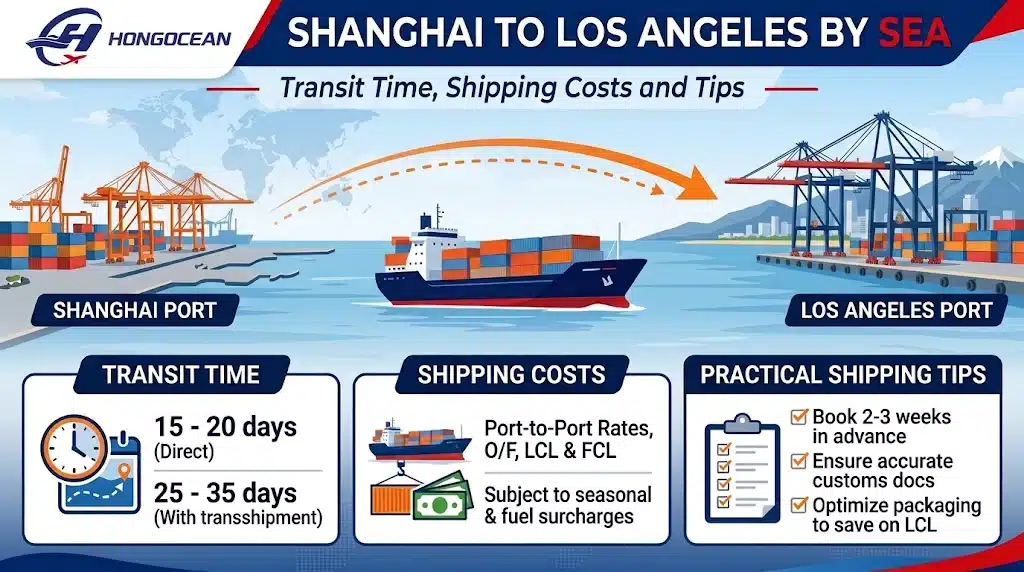
The standard ocean transit time from Shanghai to Los Angeles generally falls between 11 and 22 days for direct services. Shipments involving transshipment can take approximately 22 to 29 days, depending on the connecting port and vessel schedule.
Those figures describe the port-to-port movement. They do not include every activity required to get cargo from a supplier’s facility to a U.S. delivery address.
Three different timelines should be considered when planning an import:
| Shipping stage | Typical transit time |
|---|---|
| Expedited direct ocean service | Around 11 days |
| Standard direct ocean service | 12–18 days |
| Slower direct service | 19–22 days |
| Service involving transshipment | 22–29 days |
| Door-to-door delivery in Los Angeles | 21–30 days |
| Delivery to inland U.S. destinations by rail | 25–40 days |
The distinction becomes particularly important for businesses operating on replenishment schedules.
A retailer planning inventory around a 16-day ocean transit may still face additional days for unloading, customs processing, terminal availability, and local delivery. An importer moving cargo to Chicago or New York must also account for the inland rail journey.
In other words, a vessel’s estimated arrival date should not be treated as the date your inventory becomes available.
Why Two Shipments on the Same Route Can Take Different Amounts of Time
The Shanghai–Los Angeles route covers approximately 5,700 nautical miles, or 10,550 kilometers, using the great-circle measurement. Published route measurements can be longer when coastal approaches are included.
The distance itself is relatively predictable. The operational conditions surrounding the voyage are not.
The difference between an 11-day and a 22-day shipment is usually related to the service selected, vessel rotation, port calls, and operational scheduling.
Direct Services and Transshipment Are Different Products
A direct service moves cargo from Shanghai to Los Angeles without transferring the container to another vessel.
A transshipment service introduces an additional port call and another vessel connection. This creates more opportunities for schedule changes, missed connections, and delays.
For importers, the distinction is not simply whether one option is faster.
A direct service may be more appropriate when inventory availability is important, while a transshipment service can be worth considering when the freight savings justify a longer delivery window.
The booking should identify the actual service and routing rather than relying exclusively on the carrier’s name. One shipping line can offer multiple services with significantly different transit times.
Vessel Schedules Do Not Guarantee Cargo Availability
An estimated arrival date indicates when the vessel is expected to reach the destination port. It does not confirm when the container will be discharged, released, or available for pickup.
At Los Angeles and Long Beach, terminal operations and inland transportation can create additional waiting time after the vessel arrives.
This is particularly relevant for importers moving containers through on-dock rail facilities. A shipment may complete its ocean journey on schedule and still experience a substantial delay before continuing inland.
The practical consequence is that businesses should plan around cargo availability rather than vessel arrival alone.
What Determines the Cost of Shipping from Shanghai to Los Angeles?
Ocean freight rates are only one part of the total import cost.
For a typical container shipment, the final amount depends on the ocean rate, origin handling, destination charges, customs-related expenses, and the transportation required after the container reaches the United States.
Drewry’s World Container Index assessed the Shanghai–Los Angeles route at approximately $7,539 per 40-foot container on November 5, 2026. The indicative 20-foot benchmark was approximately $4,032–$4,620.
These figures provide a market reference, not a guaranteed booking rate.
| Cost component | What it covers |
|---|---|
| Ocean freight | Transportation from Shanghai to Los Angeles |
| Origin charges | Export handling, terminal charges and documentation |
| Destination charges | Terminal handling, CFS or other applicable port charges |
| Customs-related costs | Customs entry, applicable duties, MPF and HMF where applicable |
| ISF filing | Importer Security Filing before loading |
| Drayage | Container transportation from the port to a local facility |
| Inland transportation | Rail or truck delivery beyond Los Angeles |
The distinction between port-to-port freight and total landed cost is important.
A low ocean freight quotation does not necessarily represent the lowest overall shipping expense. Destination handling, container availability, customs issues, and inland transportation can materially change the final amount.
For businesses comparing freight forwarders, quotations should be evaluated against the same scope of services and delivery requirements.
When Does LCL Become More Expensive Than FCL?
The choice between Less than Container Load (LCL) and Full Container Load (FCL) is usually based on cargo volume, shipping frequency, and the total cost of moving the goods.
LCL allows importers to share container space with other shipments. It avoids paying for an entire container when the cargo volume is relatively small.
FCL provides exclusive use of a container and generally becomes more attractive as shipment volume increases.
However, the break-even point is not fixed.
Using the November 2026 reference figures, a 20-foot container benchmark of approximately $4,032 and an estimated LCL all-in rate of $120–$200 per CBM suggest a potential crossover around 24–28 CBM.
That calculation is illustrative rather than a universal pricing rule. Actual costs depend on origin and destination handling, cargo characteristics, consolidation fees, and local delivery charges.
The frequently quoted 13–15 CBM crossover may not reflect current market conditions.
For importers close to the FCL threshold, comparing the complete cost of both options is more useful than relying on a general volume rule.
Customs Clearance Can Affect the Delivery Schedule Before the Vessel Arrives
Ocean transportation and customs clearance are separate processes, but they need to be coordinated.
U.S. Customs and Border Protection (CBP) requires importers to meet applicable filing and entry requirements. One of the most important pre-arrival obligations for ocean shipments is the Importer Security Filing (ISF).
For shipments subject to the ISF rule, the required information must generally be submitted no later than 24 hours before the cargo is loaded onto the vessel at the foreign port.
An incomplete or inaccurate filing can expose the importer to penalties and additional compliance issues.
Other documentation requirements depend on the imported goods, including:
- Commercial invoice
- Packing list
- Bill of lading
- Correct HTS classification
- Applicable customs entry information
- Import permits or other product-specific documentation
The important point is that customs clearance should not be treated as an activity that begins only after the container arrives in Los Angeles.
Importers who prepare their documentation and coordinate with their customs broker before departure are better positioned to avoid preventable administrative delays.
A customs release also does not automatically mean the container can leave the terminal. Freight availability, terminal procedures, payment of applicable charges, and pickup appointments remain separate operational requirements.
Los Angeles Port Congestion Can Turn a Two-Week Voyage Into a Month-Long Delivery
The Port of Los Angeles and the Port of Long Beach are major gateways for cargo entering the United States from Asia.
Their importance also means that disruptions can affect a large number of importers at the same time.
For November 2026, one of the significant operational concerns has been on-dock rail congestion.
According to the operational figures reported in the original November 2026 analysis, the Port of Los Angeles had 23,716 import containers waiting for on-dock rail on November 6. Approximately 34.5% had been waiting for nine days or longer.
Across the Los Angeles–Long Beach complex, average rail-container dwell reached 7.19 days in September 2026.
These figures illustrate an important distinction: the ship can arrive on time while the inland delivery schedule continues to deteriorate.
For an importer shipping to Chicago, Dallas, Memphis, or New York, the rail connection may be just as important as the ocean service.
Several factors can affect the final delivery date:
Terminal and rail availability. Containers moving by rail may wait for equipment, available rail capacity, and terminal processing.
Blank sailings. Carriers may cancel or consolidate scheduled voyages when adjusting capacity. This can change the departure date even after an importer has planned around a published schedule.
Weather conditions. Pacific storms and other adverse weather can affect vessel routing and arrival schedules.
Labor disruptions. Industrial disputes involving port workers can affect gate operations, cargo handling, and terminal productivity.
Customs examinations. Shipments selected for inspection may require additional handling and time before release.
These factors do not affect every shipment equally. Their impact depends on the selected service, cargo routing, destination, and the operational conditions at the time of shipment.
For that reason, importers with fixed delivery commitments should maintain a reasonable schedule buffer rather than planning around the fastest advertised transit time.
Choosing Between Sea Freight and Air Freight
Sea and air freight serve different supply chain requirements.
Air freight is generally more appropriate when goods have a high value relative to their weight, inventory shortages are costly, or delivery deadlines cannot accommodate an ocean shipment.
Sea freight remains more economical for larger shipments where the additional transit time can be absorbed into inventory planning.
For the November 2026 reference period, air freight from China to North America was reported at approximately $7.76 per kilogram, while the illustrative sea freight cost was approximately $0.38 per kilogram based on a 20-tonne load in a 40-foot container.
These figures are not directly interchangeable quotations because the services, cost coverage, and shipment assumptions differ.
| Comparison | Sea Freight | Air Freight |
|---|---|---|
| Typical transit time | 11–22 days port-to-port | 5–8 days door-to-door |
| Cost structure | Lower cost per unit for larger shipments | Higher cost per kilogram |
| Suitable cargo | Bulk goods, furniture, machinery and regular inventory | Urgent orders, samples and high-value products |
| Capacity | FCL and LCL options | Based on chargeable weight and available capacity |
| Main scheduling risks | Vessel schedules, ports, customs and inland transportation | Flight capacity, security screening and customs |
The decision should be based on the cost of the delay, not transportation speed alone.
If an additional week at sea creates a stockout or production interruption, air freight may be commercially justified. If inventory is planned several weeks ahead, the additional expense may offer little operational benefit.
What Importers Should Confirm Before Booking
The most common scheduling problem is treating the freight booking as the final step in delivery planning.
In practice, several decisions need to be made before cargo leaves Shanghai.
Confirm the actual vessel service.
Ask for the service name, estimated transit time, routing, and whether the shipment involves transshipment. A general statement such as two weeks at sea does not provide enough information for a reliable inventory plan.
Establish the delivery destination.
A container delivered to a Los Angeles warehouse has a different schedule from one moving by rail to an inland distribution center. Confirm whether the quotation covers port-to-port, port-to-door, or door-to-door transportation.
Prepare customs documentation in advance.
Check the commercial invoice, packing list, product classification, importer information, and ISF filing requirements before the shipment is loaded.
Compare the complete shipping cost.
Request a breakdown of ocean freight, origin charges, destination charges, customs-related expenses, and inland delivery. This makes it easier to identify costs that are excluded from an initial quotation.
Allow for operational delays.
The fastest published sailing is not necessarily the most reliable option for a shipment with a fixed delivery deadline. Build additional time into the purchasing and replenishment schedule.
Frequently Asked Questions
How long does sea freight take from Shanghai to Los Angeles?
Direct ocean freight generally takes 11–22 days. Standard services commonly fall within 12–18 days, while shipments involving transshipment can take approximately 22–29 days.
How long does door-to-door shipping take from Shanghai to Los Angeles?
A typical door-to-door shipment takes approximately 21–30 days, depending on supplier pickup, export handling, ocean transit, customs clearance, and final delivery arrangements.
How many nautical miles is Shanghai from Los Angeles?
The standard great-circle sea distance is approximately 5,700 nautical miles, equivalent to around 10,550 kilometers.
How much does a 40-foot container cost from Shanghai to Los Angeles?
Drewry’s November 5, 2026 reference rate was approximately $7,539 per 40-foot container. Actual booking prices vary according to the carrier, service, season, equipment availability, and quotation terms. Additional charges may apply.
Is direct shipping faster than transshipment?
Generally, yes. Direct services avoid the additional vessel connection and handling required by transshipment. However, actual transit time still depends on the carrier’s service schedule and destination port operations.
What causes delays after a container arrives in Los Angeles?
Common causes include terminal congestion, customs examinations, incomplete documentation, container availability, chassis shortages, and inland rail delays.
Is LCL or FCL cheaper for shipping from Shanghai to Los Angeles?
LCL is generally suitable for smaller shipments, while FCL can become more economical as cargo volume increases. The break-even point depends on the complete origin, ocean, destination, and delivery costs rather than container volume alone.
Do I need to complete ISF before shipping from Shanghai?
Yes. For shipments subject to the U.S. ISF requirement, the importer or its authorized agent must generally submit the required information at least 24 hours before the cargo is loaded onto the vessel at the foreign port.
Can I ship from Shanghai to Chicago or New York by sea?
Cargo can move by ocean from Shanghai to Los Angeles and then continue inland by rail or truck. The total delivery time includes both the ocean journey and the inland transportation leg.
Should I choose air freight instead of sea freight?
Air freight is worth considering when delivery speed has a greater commercial value than the additional transportation cost. For larger shipments and planned inventory replenishment, sea freight is generally the more economical option.
Planning Your Next Shipment from Shanghai to Los Angeles
The shipping time from Shanghai to Los Angeles is determined by more than the distance across the Pacific. Vessel selection, port operations, customs preparation, and inland transportation all influence the date cargo becomes available.
For importers, the most reliable approach is to evaluate the complete shipping process before confirming a booking. Comparing only ocean transit times or headline freight rates can lead to unrealistic delivery expectations and unexpected expenses.
A shipment plan that accounts for the actual destination, cargo volume, customs requirements, and delivery schedule gives businesses a more accurate basis for managing inventory and controlling landed costs.
If you are arranging a shipment from Shanghai to Los Angeles, request a quotation that identifies the ocean service, estimated transit time, destination charges, customs arrangements, and final delivery scope before booking.