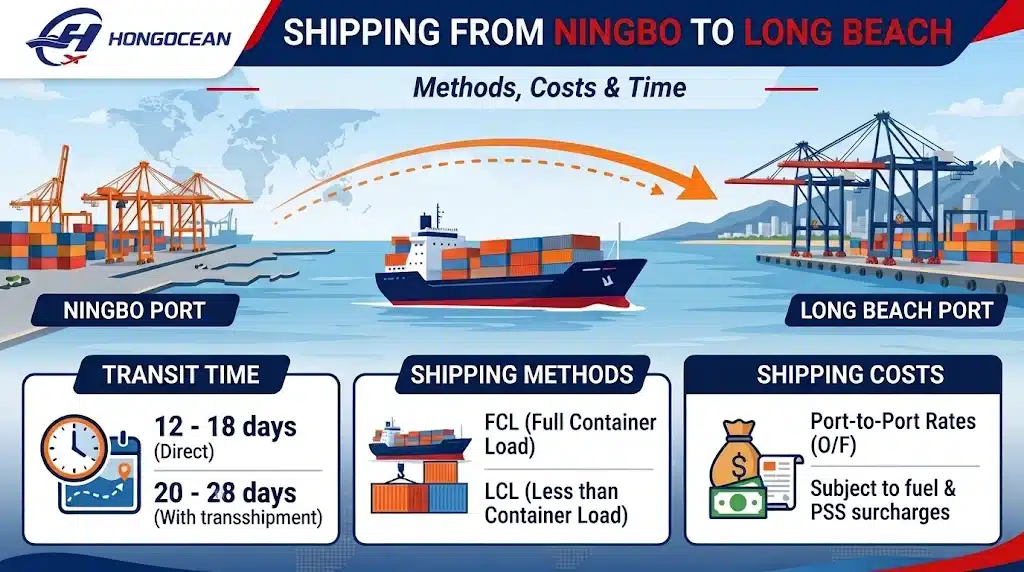
When businesses import goods from China to the United States, choosing the right shipping method can affect transportation costs, delivery schedules, and inventory management. For companies sourcing products from eastern China, shipping from Ningbo to Long Beach is a common option for moving commercial cargo to the U.S. West Coast.
The route connects Ningbo, one of China’s major manufacturing and export centers, with the Port of Long Beach in Southern California. Businesses can use ocean freight, air freight, or express shipping depending on cargo volume, delivery requirements, and budget.
However, selecting a shipping method involves more than comparing freight rates. Importers also need to consider container availability, customs clearance, destination charges, and final delivery arrangements.
In this guide, we will explain how shipping from Ningbo to Long Beach works, the available transportation options, estimated costs and transit times, and what businesses should consider before arranging a shipment.
Where Is Ningbo Port and Why Is It Important for International Shipping?
Ningbo is located in Zhejiang Province on China’s eastern coast, within the Yangtze River Delta economic region. Its location provides access to a large manufacturing base and established international shipping networks.
The Port of Ningbo-Zhoushan is a major international shipping hub, handling containerized cargo, bulk commodities, and other commercial shipments. It connects Chinese exporters with markets across North America, Europe, and Asia.
Several port areas support different shipping requirements:
- Beilun Port: A major container terminal area handling international FCL and LCL shipments.
- Zhenhai Port: Handles general cargo and other specialized freight operations.
- Daxie Port: Supports containerized cargo and specialized shipping requirements.
For businesses exporting products to the United States, Beilun is an important departure area because of its container handling capacity and established transpacific shipping connections.
Choosing the appropriate departure terminal depends on the shipping line, vessel schedule, cargo location, and booking arrangement.
What Is the Port of Long Beach and How Does It Handle Imported Cargo?
The Port of Long Beach is located in Southern California, next to the Port of Los Angeles. Together, these two ports form one of the most important container gateways for international trade in the United States.
For importers receiving goods from China, Long Beach provides access to several transportation networks that connect imported cargo with distribution centers and warehouses throughout the country.
After a vessel arrives, containers generally move through several operational stages:
- Vessel arrival and container discharge.
- Terminal handling and cargo availability.
- Customs clearance and applicable import procedures.
- Container pickup or transfer to an inland transportation facility.
- Final delivery to the consignee’s warehouse.
The time required for each stage depends on terminal operations, customs release, equipment availability, and the selected delivery method.
Businesses shipping to locations outside Southern California should also consider inland rail or trucking costs when selecting Long Beach as their destination port.
What Are the Different Shipping Methods from Ningbo to Long Beach?
Businesses can choose between ocean freight, air freight, and express shipping. Each option serves different cargo volumes and delivery requirements.
1. Ocean Freight
Ocean freight is commonly used for commercial shipments moving from Ningbo to Long Beach, particularly when cargo volume is too large for air transportation to be economical.
There are two main container shipping arrangements: Full Container Load (FCL) and Less than Container Load (LCL).
Full Container Load (FCL)
FCL allows one shipper to reserve an entire container for its cargo. The container does not need to be completely filled to qualify as an FCL shipment.
Common container options include:
| Container Type | Approximate Capacity | Typical Use |
|---|---|---|
| 20ft Standard | 28 CBM | Dense or smaller commercial shipments |
| 40ft Standard | 56 CBM | Larger commercial orders |
| 40ft High Cube | 68 CBM | Bulky or high-volume products |
| 45ft High Cube | 78 CBM | Specialized high-volume shipments |
Actual usable capacity depends on cargo dimensions, packaging, weight distribution, and applicable transportation restrictions.
FCL is often suitable for manufacturers, wholesalers, and importers moving substantial quantities of goods.
Less than Container Load (LCL)
LCL allows multiple businesses to share space inside one shipping container. Each shipper pays for the space occupied by their cargo rather than reserving the entire container.
This option can help smaller businesses avoid paying for unused container capacity.
However, LCL shipments require consolidation at origin and deconsolidation at destination. These additional handling stages can affect transit time and cargo availability.
The choice between FCL and LCL should be based on total transportation costs, shipment volume, cargo characteristics, and delivery requirements.
2. Air Freight
Air freight is generally selected when delivery speed is more important than transportation cost.
For shipments from Ningbo to Long Beach, cargo may depart through Ningbo Lishe International Airport (NGB), Shanghai Pudong International Airport (PVG), or Hangzhou Xiaoshan International Airport (HGH), depending on available airline services and cargo capacity.
The primary airport serving the Long Beach area is Los Angeles International Airport (LAX).
Air freight is commonly used for:
- High-value commercial products.
- Urgent inventory replenishment.
- Product samples and smaller orders.
- Electronics and specialized components.
- Goods with limited delivery windows.
Air cargo rates are generally calculated using chargeable weight, which considers both actual weight and volumetric weight.
For standard air freight, the volumetric weight is commonly calculated as:
Volumetric Weight (kg) = Length × Width × Height (cm) ÷ 6,000
The airline or service provider uses the greater of actual and volumetric weight when calculating chargeable weight, subject to its applicable pricing rules.
3. Express Shipping
Express shipping is designed for smaller shipments that need quick, door-to-door transportation.
International carriers such as DHL, FedEx, and UPS provide services connecting China with the United States.
Compared with conventional air freight, express services generally include integrated pickup, transportation, tracking, and basic customs handling.
They are commonly used for:
- Documents and product samples.
- Small e-commerce orders.
- Replacement parts.
- Urgent business shipments.
- Lightweight commercial packages.
Express shipping is convenient, but its pricing can become expensive as shipment weight and dimensions increase. Businesses should also check carrier restrictions for oversized cargo and regulated products before booking.
How Much Does It Cost to Ship from Ningbo to Long Beach?
Shipping costs depend on the transportation method, cargo volume, weight, service level, and final delivery location.
For ocean freight, container size is one of the main pricing factors. For air freight, chargeable weight and service level are particularly important.
The following figures are historical indicative estimates published in Dantful’s 2025 route guide, not current November 2026 booking quotations.
Estimated Ocean Freight Costs
| Container Type | Capacity | Historical Estimated Freight Cost |
|---|---|---|
| 20ft Standard | 28 CBM | $1,300–$2,100 |
| 40ft Standard | 56 CBM | $2,200–$3,500 |
| 40ft High Cube | 68 CBM | $2,350–$3,700 |
These figures cover estimated ocean freight only. They do not include all origin and destination handling charges, customs duties, taxes, or inland transportation.
Estimated Air Freight Costs
The following historical 2025 estimates provide a general comparison of standard air freight and express services.
| Chargeable Weight | General Air Freight | Express Service |
|---|---|---|
| 45–100 kg | $5.80–$7.20/kg | $8.00–$10.50/kg |
| 100–300 kg | $5.20–$6.80/kg | $7.50–$9.80/kg |
| 300–500 kg | $4.80–$6.40/kg | $7.00–$9.00/kg |
| 500+ kg | $4.30–$6.00/kg | $6.50–$8.50/kg |
Actual rates may vary according to airline capacity, fuel charges, cargo dimensions, departure airport, and seasonal demand.
What Factors Affect Shipping Costs?
Several factors influence the total cost of moving cargo from Ningbo to Long Beach.
Container size and cargo volume: A 20-foot container may be sufficient for smaller or heavier shipments, while a 40-foot or high-cube container can accommodate larger volumes.
Transportation method: Ocean freight generally offers lower transportation costs for large shipments, while air and express services are more suitable for time-sensitive cargo.
Seasonal demand: Freight rates may increase during peak shipping periods, including the months leading up to major holidays and the Chinese New Year.
Fuel and carrier surcharges: Fuel-related charges, equipment availability, and carrier pricing adjustments can affect the final quotation.
Destination charges: Terminal handling, documentation, customs-related services, and container pickup may add to the total cost.
Inland transportation: Delivery beyond Long Beach requires additional trucking or rail arrangements, depending on the destination.
When comparing quotations, businesses should confirm exactly which services and charges are included rather than relying only on the basic ocean freight rate.
How Long Does Shipping from Ningbo to Long Beach Take?
Transit time depends on the transportation method, vessel routing, departure schedule, and destination handling arrangements.
The following estimates provide a general planning reference.
| Shipping Method | Estimated Transit Time | Transportation Scope |
|---|---|---|
| Direct FCL | 13–16 days | Port-to-port |
| Transshipment | 18–24 days | Port-to-port |
| LCL | 16–22 days | Port-to-port |
| Standard Air Freight | 3–5 days | Airport-to-airport |
| Express Air Freight | 1–3 days | Airport-to-airport |
| Door-to-Door Shipping | Additional 3–7 days | Depends on pickup, clearance and delivery |
Ocean transit times can change because of vessel schedules, port congestion, weather conditions, and transshipment connections.
LCL shipments may also require additional time for cargo consolidation and deconsolidation.
For businesses with fixed delivery deadlines, it is important to distinguish between port-to-port transit time and the complete door-to-door schedule.
What Is the Difference Between Door-to-Door, DDP, and DDU Shipping?
Door-to-door shipping refers to a transportation arrangement that covers cargo movement from the supplier’s location to the buyer’s specified delivery address.
Depending on the agreement, the service may include factory pickup, export handling, international transportation, import customs clearance, and final delivery.
The allocation of customs responsibilities and costs depends on the selected Incoterm.