
When you ship goods to the United States by LCL (Less than Container Load), ocean freight is not the only cost you need to consider. Once your goods arrive at a U.S. port, there are several local charges that must be paid before your shipment can be released.
These charges may include CFS handling, terminal handling, customs clearance, documentation, warehouse storage, and inland delivery.
Many importers focus only on the ocean freight rate when comparing shipping companies. However, the destination charges can make a big difference to the final shipping cost.
So, how much should you expect to pay when shipping LCL to the USA? What fees are included? And how can you avoid unnecessary expenses?
In this guide, we will explain the main LCL destination charges in the USA and help you understand what to expect when your shipment arrives.
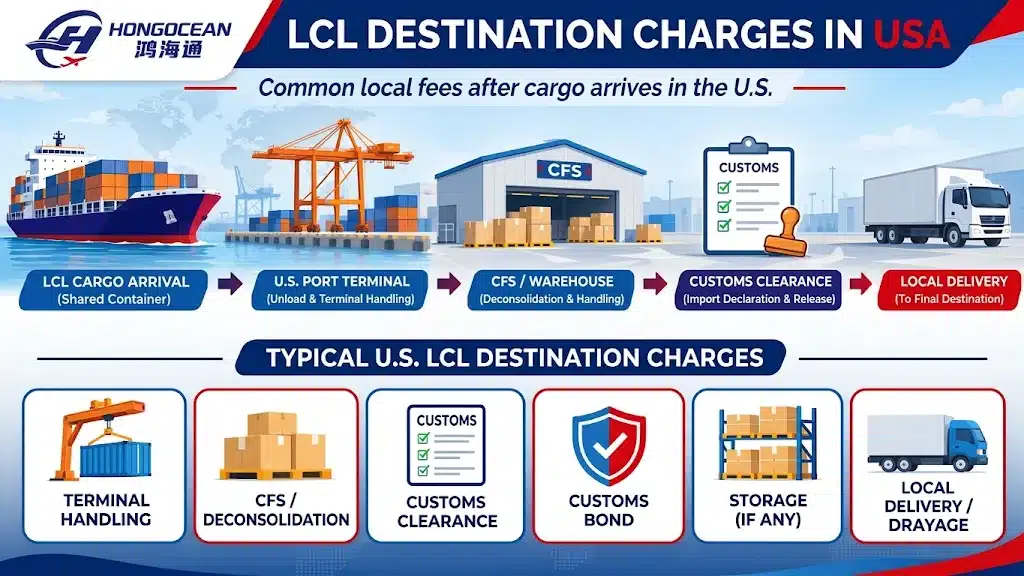
What Are LCL Destination Charges in the USA?
First, let’s understand what LCL shipping means.
LCL stands for Less than Container Load. It is a shipping method where your goods share a container with cargo from other importers. You only pay for the space your shipment occupies instead of booking an entire container.
This is a good option if you have a relatively small shipment from China to the USA and do not need a full container.
However, unlike FCL shipping, LCL cargo needs to go through additional handling procedures at the destination port.
For example, when a consolidated container arrives in the United States, it must be transported to a Container Freight Station (CFS). The warehouse team will unload the container, separate each shipment, and prepare the cargo for customs clearance and collection.
During this process, several local charges will be generated.
These are what we call LCL destination charges.
Generally, the process includes:
- Vessel Arrival: Your consolidated container arrives at a U.S. port.
- Terminal Handling: The container is unloaded and transferred from the marine terminal.
- CFS Deconsolidation: Your goods are unloaded, sorted, and separated from other shipments.
- Customs Clearance: Your customs broker submits the required import documents to U.S. Customs and Border Protection (CBP).
- Cargo Release: Outstanding fees and required documents are settled before the goods are released.
- Final Delivery: You arrange pickup or have the goods delivered to your warehouse or business address.
As you can see, LCL shipping involves more than simply moving goods from one port to another.
What Are the Main LCL Destination Charges in the USA?
Now, let’s look at the charges you may encounter when importing goods into the United States.
The exact amount depends on your destination port, freight forwarder, CFS warehouse, cargo volume, and the services included in your shipping agreement.
Here are the most common fees:
| Charge Type | What Does It Cover? | Billing Method |
|---|---|---|
| CFS Deconsolidation Fee | Unloading and separating individual shipments | Per CBM or W/M |
| Destination Terminal Handling | Handling containers at the marine terminal | Per shipment or tariff |
| Documentation Fee | Arrival notice, delivery order, and paperwork | Per shipment or document |
| Customs Brokerage Fee | Preparing and submitting customs entries | Per entry or shipment |
| Storage Fee | Holding cargo beyond the free storage period | Per day, CBM, or pallet |
| Customs Examination Fee | Additional handling during customs inspections | Based on actual costs |
| Inland Trucking | Transporting goods from the CFS to your address | Per shipment or route |
Let’s take a closer look at each charge.
1. CFS Deconsolidation and Handling Fees
When your LCL container arrives at the destination port, it cannot be collected immediately.
The container must first be transported to a CFS warehouse, where workers unload the cargo and separate shipments belonging to different importers.
This service generates CFS handling and deconsolidation fees.
In most cases, these fees are calculated according to the cargo volume (CBM) or weight/measurement (W/M). Some warehouses also have minimum charges for small shipments.
For example, if you ship 2 CBM of goods from China to Los Angeles, the warehouse will calculate the handling charge based on its applicable rate and billing rules.
Before shipping, you should ask your freight forwarder whether the quoted destination fee includes unloading, sorting, and warehouse handling.
2. Destination Terminal Handling Charges
Destination Terminal Handling Charges (DTHC) cover the handling of containers at the destination marine terminal.
These costs are associated with terminal operations, container unloading, and related handling services.
Depending on your carrier and shipping agreement, DTHC may already be included in the ocean freight rate or charged separately at the destination.
This is why you should always check whether terminal handling is prepaid or payable when your goods arrive in the USA.
3. Documentation and Delivery Order Fees
Documentation is another important part of LCL shipping.
When your shipment arrives in the United States, the shipping company or its destination agent needs to process the arrival documents and arrange cargo release.
Common documentation charges include:
- Delivery Order (D/O) issuance.
- Bill of Lading processing.
- Arrival Notice administration.
- Cargo release documentation.
If your documents are incomplete or the required fees have not been paid, your cargo release may be delayed.
To avoid this situation, make sure your freight forwarder has the correct consignee information and shipping documents before the vessel arrives.
4. Customs Brokerage and Import Fees
Customs clearance is an essential step when importing goods into the United States.
Your customs broker will prepare and submit the necessary import entry documents to U.S. Customs and Border Protection (CBP).
The customs brokerage fee is a service charge paid to the broker. It is different from government-imposed import duties and taxes.
Depending on your shipment, you may also need to consider:
- Import duties based on the applicable HTS classification.
- Merchandise Processing Fee (MPF).
- Harbor Maintenance Fee (HMF), where applicable.
- Customs bond fees.
- Additional customs examination expenses.
Not every shipment has the same customs requirements. The amount depends on the product, declared value, country of origin, applicable trade measures, and import procedures.
If you are importing commercial goods from China, it is better to prepare your commercial invoice, packing list, and other required documents before the shipment arrives.
5. Storage and Additional Handling Fees
What happens if your goods arrive at the CFS warehouse but you cannot collect them immediately?
In this situation, storage fees may apply.
Most destination warehouses provide a limited free storage period. If your cargo stays beyond that period, you may need to pay additional warehouse charges.
There are several common reasons why this happens:
- Customs clearance takes longer than expected.
- Required import documents are missing.
- The consignee does not arrange pickup on time.
- Customs inspection delays cargo release.
- Delivery arrangements are not ready.
You should also understand that CFS storage, demurrage, and detention are different charges.
CFS storage applies to cargo held inside a warehouse. Demurrage generally relates to container use within the terminal, while detention relates to keeping carrier equipment beyond the allowed time.
Understanding these differences will help you avoid confusion when reviewing your final shipping invoice.
6. Inland Trucking and Final Delivery
After customs clearance and cargo release, you still need to get your goods from the destination CFS to your warehouse or business address.
This is where inland trucking comes in.
The delivery cost depends on several factors:
- Distance between the CFS warehouse and your destination.
- Cargo volume and gross weight.
- Number of pallets or packages.
- Truck type and delivery requirements.
- Residential or commercial delivery arrangements.
For example, delivering cargo from a Los Angeles CFS to a nearby commercial warehouse will generally cost less than transporting the same shipment to a destination several hundred miles inland.
Please remember that port-to-port LCL shipping does not automatically include final delivery.
Before confirming your shipment, ask whether the quotation covers CFS pickup only or includes transportation to your final address.
How Are LCL Destination Charges Calculated?
You may have noticed that some destination charges are calculated per CBM, while others are charged per shipment.
Why is that?
The reason is simple: different services use different billing methods.
W/M Calculation for LCL Shipping
For LCL ocean freight, the Weight or Measurement (W/M) principle is commonly used to calculate the chargeable quantity.
The basic calculation is:
- 1 CBM = 1 measurement unit.
- 1 metric ton = 1 weight unit.
- The higher of the two values is used as the chargeable quantity.
Let’s look at two examples:
| Shipment | Cargo Volume | Gross Weight | Chargeable Quantity |
|---|---|---|---|
| Shipment A | 2.4 CBM | 1,100 kg | 2.4 W/M |
| Shipment B | 0.8 CBM | 1,200 kg | 1.2 W/M |
For Shipment A, the cargo volume is greater than its weight in metric tons. Therefore, the shipment is charged based on 2.4 CBM.
For Shipment B, the weight is greater than the cargo volume. Therefore, the chargeable quantity is 1.2 W/M.
Keep in mind that individual CFS warehouses may apply different billing rules, minimum quantities, and measurement standards.
Per CBM vs. Fixed Shipment Fees
Generally, LCL destination charges fall into two categories.
Volume-based charges
These fees are calculated according to the cargo volume or chargeable weight.
Examples include:
- CFS handling.
- Deconsolidation.
- Certain warehouse services.
Fixed shipment charges
These fees are charged per shipment, document, or bill of lading.
Examples include:
- Documentation fees.
- Delivery Order fees.
- Administrative charges.
This is particularly important when you ship small quantities.
Even if your cargo occupies less than 1 CBM, you may still need to pay a minimum handling fee and fixed documentation charges.
Minimum Charges and Cargo Remeasurement
Another thing you should pay attention to is the final cargo measurement.
When you book an LCL shipment, your freight forwarder usually calculates the initial shipping cost based on the dimensions and weight you provide.
However, the destination warehouse may remeasure the cargo after receiving it.
If the actual volume or weight is higher than the original booking information, your final invoice may increase.
To avoid unnecessary differences, make sure you provide accurate cargo dimensions, gross weight, package quantities, and a complete packing list before shipping.
How Much Do LCL Destination Charges Cost in the USA?
This is probably one of the first questions you want answered.
The fact is that there is no single fixed rate for all U.S. ports.
Destination charges vary depending on the CFS warehouse, carrier, freight forwarder, cargo volume, and services required.
As a general reference, the following figures can help you estimate some common destination expenses:
| Destination Charge | Estimated Cost |
|---|---|
| CFS Handling | $15–$40 per CBM |
| Broader CFS-Related Charges | $30–$80 per CBM |
| Destination Terminal Handling | $100–$250 per shipment |
| Documentation and D/O | $50–$100 per shipment |
| CFS Storage After Free Time | $5–$15 per CBM per day |
| Customs Brokerage | Depends on broker and service scope |
| Inland Trucking | Depends on destination and delivery requirements |
These figures are indicative references, not fixed U.S. port tariffs. Actual charges may be different depending on the service provider and the destination warehouse.
Some forwarders combine several handling services into one charge, while others list each item separately.
So, when comparing quotations, make sure you understand exactly what is included.
Example: Calculating LCL Destination CFS Costs
Let’s say you are importing goods from China to the United States with the following shipment details:
- Cargo volume: 2.4 CBM.
- Gross weight: 1,100 kg.
- Destination CFS rate: $15–$40 per CBM.
First, we calculate the chargeable quantity.
2.4 CBM is greater than 1.1 metric tons, so the chargeable quantity is 2.4 W/M.
Then:
2.4 × $15–$40 = $36–$96
Your estimated CFS handling charge would therefore be $36–$96 under this example rate.
However, this is only the CFS handling cost. You still need to consider terminal handling, documentation, customs brokerage, storage, and inland delivery if they are not included in your quotation.
What Determines the Total LCL Shipping Cost to the USA?
When you ship goods from China to the USA, destination charges are only one part of your total shipping cost.
Several factors can affect the final amount.
1. Shipment Volume and Weight
The larger or heavier your shipment is, the more you may need to pay for LCL transportation and handling.
Most LCL freight rates use the W/M calculation, so accurate cargo measurements are important.
2. Origin and Destination Charges
Your shipment may involve receiving, loading, consolidation, unloading, sorting, and warehouse handling at both ends of the route.
These local fees should be included when calculating your total logistics budget.
3. Ocean Freight Rates
Ocean freight rates change according to the shipping route, carrier capacity, market demand, and shipping season.
A lower ocean freight rate does not necessarily mean a lower total shipping cost.
4. Additional Surcharges
Depending on the carrier and quotation, additional charges may include:
- Bunker Adjustment Factor (BAF).
- Fuel surcharges.
- Currency Adjustment Factor (CAF).
- Peak Season Surcharge (PSS).
You should confirm which surcharges are included before booking.
5. Destination Services
Customs clearance, cargo release, storage, and inland trucking can all increase your final landed cost.
If you need door-to-door delivery, make sure these services are included in your quotation.
LCL vs. FCL: Which Is Better for Your Shipment?
If you have around 15–20 CBM of cargo, you may want to compare LCL and FCL shipping.
LCL is usually a good choice for smaller shipments because you only pay for the space your cargo occupies.
FCL may become more economical when your shipment volume increases, depending on the route and container rates.
Here is a simple comparison:
| Comparison | LCL Shipping | FCL Shipping |
|---|---|---|
| Container Space | Shared with other importers | Entire container |
| Cost Calculation | Usually per CBM or W/M | Per container |
| Cargo Handling | More consolidation and deconsolidation | Fewer shared-cargo handling stages |
| Suitable For | Small and medium shipments | Larger shipments |
| Destination Handling | Individual cargo separation required | Container-level handling |
| Delivery | Usually arranged after CFS release | Container pickup and delivery |
Which option should you choose?
It depends on your cargo volume, delivery schedule, destination, and overall logistics budget.
Before making a decision, ask your freight forwarder to compare both options based on the complete shipping cost rather than ocean freight alone.
Why Is Your Final LCL Invoice Higher Than the Original Quote?
Have you ever received a shipping quotation that looked very attractive, only to find that the final invoice was much higher?
This is a common problem for importers who focus only on the base ocean freight rate.
There are several reasons why this happens.
Destination Services Were Not Included
Some freight quotations only cover ocean transportation.
Destination CFS handling, terminal fees, documentation, and cargo release may be charged separately after arrival.
Always ask your forwarder for a complete breakdown before shipping.
Actual Cargo Measurements Were Different
If the actual cargo volume or gross weight is higher than the booking information, the final chargeable quantity may increase.
This is why accurate cargo measurements are so important.
Minimum Charges and Additional Services
Small shipments may still be subject to minimum handling and documentation fees.
Additional services such as repacking, palletization, and special cargo handling can also increase the final cost.
Storage and Cargo Release Delays
If you do not arrange customs clearance and cargo collection within the permitted free storage period, additional warehouse fees may apply.
Missing documents and delayed customs procedures can make the situation even more expensive.
Incoterms and Payment Responsibilities
Your shipping terms also determine who is responsible for different transportation costs.
For example, under CIF terms, the seller pays for ocean freight and insurance to the named destination port. However, the buyer is generally responsible for import customs clearance and duties.
Other destination charges depend on the shipping agreement and the specific services included.
Therefore, before purchasing goods from your supplier, make sure you understand which charges are prepaid and which ones you will need to pay when the shipment arrives.
How to Avoid Unexpected LCL Shipping Costs in the USA
So, how can you reduce destination charges and avoid unnecessary expenses?
Based on our experience in international freight forwarding, there are several things you should do before your cargo leaves China.
1. Choose FOB Terms and Control Your Freight
If you regularly import goods from China, FOB shipping terms can give you more control over your freight arrangements.
You can appoint your own freight forwarder, compare different shipping routes, and check destination charges before the goods leave China.
If your supplier offers CIF terms, ask for a clear explanation of which U.S. destination charges are excluded from the quotation.
2. Request a Detailed Freight Quotation
Never compare shipping companies based only on their ocean freight rates.
Ask for a detailed quotation that includes:
- Origin CFS charges.
- Ocean freight.
- Destination CFS handling.
- Destination Terminal Handling Charges (DTHC).
- Delivery Order fees.
- Customs brokerage.
- Storage charges, if applicable.
- Inland trucking.
Also, check the billing method and minimum charges for each service.
This will help you understand the actual cost of shipping your goods to the USA.
3. Prepare Customs Documents in Advance
Customs clearance is another important part of the shipping process.
For shipments subject to the Importer Security Filing (ISF) requirement, the required filing must generally be submitted no later than 24 hours before the cargo is loaded onto the vessel at the foreign port.
You should also prepare your commercial invoice, packing list, and other required import documents in advance.
Working with an experienced customs broker can help you reduce documentation errors and avoid unnecessary delays.
4. Arrange Cargo Pickup on Time
Once your shipment is released, arrange collection as soon as possible.
Check the destination CFS free storage period before your goods arrive and make sure your trucking arrangements are ready.
This is one of the simplest ways to avoid additional warehouse storage charges.
5. Measure and Package Your Cargo Properly
Accurate cargo measurements help your freight forwarder calculate the correct shipping cost.
Before booking, confirm:
- Total number of packages.
- Length, width, and height of each package.
- Total cargo volume in CBM.
- Gross weight.
- Pallet requirements.
Proper packaging can also reduce the risk of cargo damage and additional handling expenses.
How Can Hongocean Help with Your LCL Shipping to the USA?
If you are importing goods from China to the United States, finding a reliable freight forwarder can make the entire process much easier.
At Hongocean, we understand that shipping is not just about finding the lowest ocean freight rate. You also need to know the destination charges, customs requirements, cargo handling arrangements, and final delivery costs before making a decision.
We provide international shipping solutions for importers, wholesalers, manufacturers, and e-commerce businesses.
Our services include:
- LCL Shipping: Consolidate your goods with other shipments and pay for the space you use.
- FCL Shipping: Arrange full container transportation for larger shipments.
- Air Freight: Ship urgent goods from China to the USA with flexible air freight options.
- Customs Clearance: Help prepare the required shipping and customs documentation.
- Door-to-Door Shipping: Arrange transportation from your supplier in China to your final destination in the USA.
- Warehousing: Receive, store, and consolidate goods from different Chinese suppliers.
- Cargo Inspection: Check cargo condition and packaging before shipment.
- Cargo Insurance: Arrange cargo insurance options to help protect your shipment.
Whether you are shipping a few CBM of commercial goods or arranging regular shipments from China, we can help you compare different shipping solutions.
You don’t need to deal with every shipping detail on your own. Just tell us your cargo information, departure city, and final destination. Our team will help you find a suitable shipping solution based on your requirements.
Contact Hongocean today to get an LCL shipping quote from China to the USA.
Frequently Asked Questions About LCL Destination Charges in the USA
1. What Are LCL Destination Charges in Shipping?
LCL destination charges are local service fees generated after a consolidated container arrives at the destination port. They may include CFS handling, terminal handling, documentation, customs brokerage, storage, and cargo release.
2. Are LCL Destination Charges Included in Ocean Freight?
Not always.
Some freight forwarders include certain destination services in their ocean freight quotations, while others charge them separately.
You should always request an itemized quotation before booking.
3. How Are LCL Destination Charges Calculated?
Some charges are calculated according to cargo volume (CBM) or weight/measurement (W/M), while others are charged per shipment, bill of lading, or document.
Minimum charges may also apply to smaller shipments.
4. Who Pays Destination Charges Under CIF Shipping Terms?
Under CIF terms, the seller pays for ocean freight and insurance to the named destination port.
The buyer is generally responsible for import customs clearance and duties. Other local charges depend on the agreed shipping arrangements and carriage contract.
5. Are Customs Duties Included in LCL Shipping Costs?
Generally, customs duties and government fees are separate from freight forwarding and CFS service charges.
When importing goods into the USA, you should also consider applicable import duties, MPF, HMF, and other government fees.
6. How Can I Reduce LCL Destination Charges in the USA?
You can reduce unnecessary expenses by comparing itemized freight quotations, providing accurate cargo measurements, preparing customs documents in advance, and arranging cargo pickup before the free storage period expires.
Working with an experienced freight forwarder can also help you understand destination fees before your shipment leaves China.
7. Is LCL Shipping Cheaper Than FCL Shipping?
For smaller shipments, LCL is often more economical because you only pay for the cargo space you use.
However, when your shipment volume increases, FCL may offer better overall value. You should compare the complete freight cost and destination charges before choosing a shipping method.