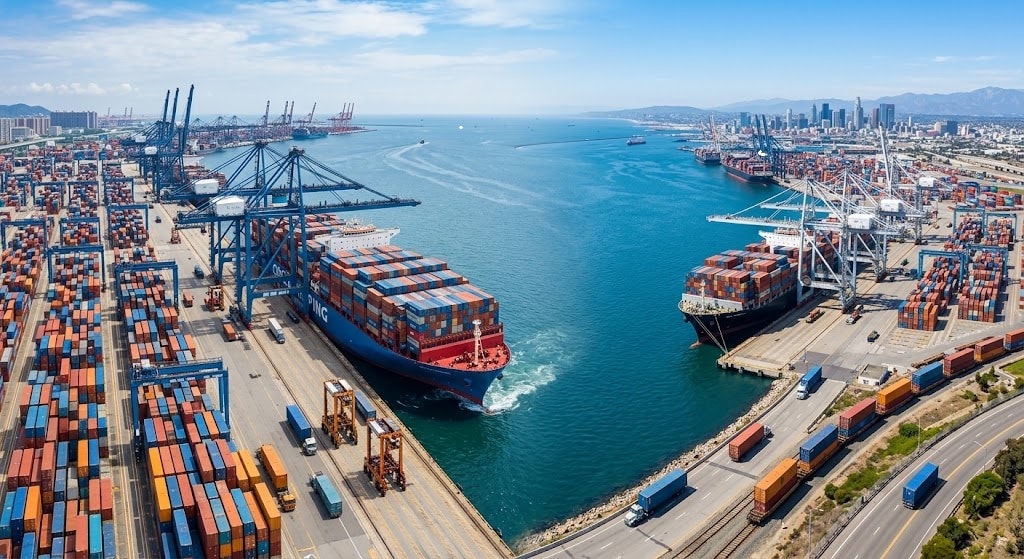
Shipping from China to Uzbekistan is mainly a question of balancing cost, cargo size, and delivery time. For most importers, consolidated truck freight offers the most practical option for regular commercial cargo, while air freight makes more sense when the shipment is small or time-sensitive. Rail is worth considering for larger, more uniform shipments where transit time is less important than the cost per container.
As of September 2026, consolidated truck freight from China to Tashkent generally takes around 15 to 25 days, with rates starting from about $110 per m³ depending on cargo density. Air freight typically takes 5 to 10 days at around $9–12 per kg, while a rail container takes roughly 20 to 35 days, with a 20ft container costing about $2,800–5,500.
The main commercial corridor runs through Yiwu → Urumqi → Khorgos → Almaty → Shymkent → Tashkent, although alternative routes through Kyrgyzstan can make more sense for cargo destined for the Fergana Valley.
The important part is not simply choosing the cheapest rate. The way your shipment is measured, consolidated, cleared through customs, and delivered in Uzbekistan can have just as much impact on the final cost.

Shipping methods from China to Uzbekistan compared
The right shipping method depends mostly on how much you are moving, how quickly you need it, and what the cargo actually contains.
| Mode | Transit Time | Typical Cost | Best For |
|---|---|---|---|
| Consolidated Truck Freight | 15–25 days | From $110/m³ | Wholesale cargo, bulky goods, regular commercial shipments |
| Air Freight | 5–10 days | $9–12/kg | Urgent, light, valuable or time-sensitive goods |
| Rail Container | 20–35 days | $2,800–5,500 per 20ft | Larger shipments, equipment and raw materials |
Truck freight is generally the practical middle ground. You are not paying for an entire container, but you also avoid the much higher cost of moving smaller commercial shipments by air.
A useful rule of thumb is simple: urgent and compact cargo goes by air; heavy or bulky cargo usually goes by truck; larger uniform shipments are worth pricing as a full container. GSR’s current comparison places consolidated truck freight at 15–25 days, air at 5–10 days and rail at 20–35 days.
For many importers, the decision is less about finding the lowest headline rate and more about finding the lowest cost per delivered unit. A slightly more expensive service may still make sense if it avoids waiting for several suppliers, reduces handling, or gets inventory into Tashkent before a stockout.
Consolidated cargo from China to Uzbekistan
Consolidated cargo is useful when you have goods to import but not enough volume to justify a full container.
Instead of booking an entire truck or container, shipments from several customers are combined at a warehouse in China. You pay for the space your cargo actually uses. In practice, this works much like LCL shipping: truck cargo is generally calculated by volume and air freight by chargeable weight.
This model is particularly useful for shipments between roughly 10 kg and 15 m³, including goods for online sellers, wholesalers, retailers and businesses testing a new product line. Once the shipment becomes large enough, it is worth comparing the consolidated rate with a dedicated container because the economics can change quickly.
Yiwu is an important consolidation point because of its huge small-commodity wholesale market. Suppliers can send cargo directly to the warehouse, where multiple orders can be received, measured, checked and combined before the international shipment begins.
This also removes one common headache for new importers: you do not necessarily need your own warehouse or a Chinese-speaking employee in China. The supplier can deliver to the designated warehouse using the shipment reference or shipping mark.
Main routes from China to Uzbekistan
The main road corridor to Tashkent runs through Kazakhstan:
Yiwu → Xi’an → Lanzhou → Urumqi → Khorgos → Almaty → Shymkent → Tashkent
The route covers roughly 5,000 km and normally takes around 15–25 days after departure from the China warehouse.
The first major border point is Khorgos, where Chinese export procedures and border processing take place before the cargo continues through Kazakhstan.
From Khorgos, the shipment moves through Almaty and Shymkent before entering Uzbekistan and continuing toward Tashkent.
There is also an alternative route through Kyrgyzstan:
Kashgar → Irkeshtam or Torugart → Osh → Andijan → Tashkent
This route can be useful for cargo going into the Fergana Valley because of its geography. However, mountain conditions can make the route less predictable during winter.
Rail freight
Rail containers generally cross the China–Kazakhstan border through Dostyk or Altynkol, continue toward Saryagash and then move into Uzbekistan toward Tashkent.
Rail transit is generally around 20–35 days, making it slower than air and comparable to or somewhat longer than consolidated road freight, but it can become more attractive as shipment volume increases.
One point worth keeping in mind: the China–Kyrgyzstan–Uzbekistan railway is still under construction and should not be treated as an operating 2026 freight option.
How the shipping process works
For most importers, the process is fairly straightforward once the cargo information is known.
1. Get a freight quote
Start with the product description, approximate weight, dimensions, number of cartons and delivery city.
The more accurate the cargo information is, the more useful the initial quote will be. For consolidated shipments, the dimensions can be just as important as the gross weight because the shipping rate may be determined by volume or density.
2. Send the cargo to the China warehouse
Once the shipping method is confirmed, the supplier delivers the goods to the designated warehouse in China.
For consolidated shipments, each carton should normally carry the correct shipment reference or shipping mark. This is what allows the warehouse to identify your cargo when several suppliers are delivering goods at the same time.
3. Warehouse receiving and inspection
The warehouse receives the cargo, checks the pieces and records the weight and dimensions.
Photos can also be provided at intake, which is particularly useful when several suppliers are involved. If necessary, additional services such as inspection, repacking and insurance can be arranged.
4. Consolidate and prepare the shipment
If you are buying from several Chinese suppliers, the warehouse can hold the shipments and combine them into one international shipment.
This is one of the practical advantages of consolidation. Instead of paying for several separate international shipments, you can wait until the orders have arrived and move them together.
The warehouse storage period is normally limited, so it is worth coordinating supplier delivery dates rather than allowing cargo to sit indefinitely.
5. International transportation and customs
Once the cargo is consolidated and loaded, it moves toward Uzbekistan through the selected route.
For the main road corridor, this means crossing at Khorgos and continuing through Kazakhstan. The freight forwarder coordinates the transportation and customs documentation along the route.
For commercial imports into Uzbekistan, customs clearance requires the appropriate declaration and supporting documents. Duties, VAT and other applicable customs charges depend on the goods and their classification.
6. Delivery in Uzbekistan
After customs clearance, the cargo arrives at the Tashkent warehouse or continues to the final delivery address.
For businesses outside Tashkent, domestic delivery can be arranged separately. The final cost depends on the destination and shipment size.
The key point is that international freight is only one part of the landed cost. Before comparing two quotes, make sure you know whether customs clearance, duties, VAT, warehouse handling and final delivery are included.
How much does shipping from China to Uzbekistan cost?
Consolidated truck freight is generally priced according to cargo density rather than using one flat price per cubic meter.
Density is calculated as:
Density = Weight (kg) ÷ Volume (m³)
As of September 2026, the indicative truck rates are:
| Cargo Density | Estimated Rate |
|---|---|
| Up to 100 kg/m³ | $110/m³ |
| 101–150 kg/m³ | $130/m³ |
| 151–200 kg/m³ | $160/m³ |
| 201–250 kg/m³ | $180/m³ |
| 251–300 kg/m³ | $200/m³ |
| 301–350 kg/m³ | $230/m³ |
| 351–400 kg/m³ | $260/m³ |
| 401–450 kg/m³ | $280/m³ |
| 451–500 kg/m³ | $290/m³ |
| 501–700 kg/m³ | $300/m³ |
| 701–1,000 kg/m³ | $320/m³ |
| 1,000+ kg/m³ | $0.55/kg |
These are estimated September 2026 rates rather than fixed market prices. The final charge depends on the cargo measurements and the actual shipment arrangement.
For example, if you have 180 kg of cargo occupying 2 m³, the density is 90 kg/m³. At the $110/m³ rate, the freight portion would be approximately $220.
For very dense cargo, the pricing method can switch to a kilogram basis. A shipment weighing 1,200 kg and occupying 1 m³, for example, would fall into the $0.55/kg band, giving a freight charge of approximately $660.
Air freight is more straightforward: current indicative rates are around $9–12/kg, with standard cargo toward the lower end and certain branded or more sensitive cargo toward the higher end.
What is included in the freight rate?
Depending on the service, the quoted freight may include warehouse receiving, measuring, consolidation, packing and delivery to the Tashkent warehouse.
However, insurance, customs duties and VAT are separate costs unless the quotation specifically states otherwise.
This is important when comparing freight forwarders. A $110/m³ quote is not necessarily cheaper than a $130/m³ quote if the second price includes services that the first one bills separately.
Customs when importing from China to Uzbekistan
Commercial shipments entering Uzbekistan need to be properly declared and classified.
The applicable import duty depends on the HS code and type of goods, while VAT and customs clearance charges may also apply. GSR’s current guide notes that commercial imports can involve duty of 0–30% depending on the HS classification, together with 12% VAT and the applicable customs fee.
This is why the product description alone is not enough to calculate the final landed cost. The same general product category can have different customs treatment depending on its exact specification and HS classification.
For importers bringing goods into Uzbekistan for resale, the customs declaration is particularly important because it provides the formal basis for legally selling the goods through a shop or marketplace.
Before shipping, it is worth checking:
- Product description and HS code
- Commercial invoice
- Packing list
- Country of origin
- Customs value
- Applicable import duty
- VAT
- Any required certificates or permits
Restricted products should be checked before booking transportation. Certain goods may require certificates, while products such as lithium batteries, liquids or aerosols may need a specific transportation method. Some categories are prohibited altogether.
How long does shipping from China to Uzbekistan take?
Transit time depends on the mode and where the clock starts.
| Shipping Method | Typical Transit Time |
|---|---|
| Consolidated Truck | 15–25 days |
| Air Freight | 5–10 days |
| Rail Container | 20–35 days |
These figures generally refer to transportation after departure from the China warehouse rather than the complete supplier-to-door timeline.
That distinction matters.
If your supplier needs five days to prepare the order, another two or three days to deliver it to the consolidation warehouse, and the shipment then spends 15–25 days in transit, the actual supplier-to-door lead time will be longer than the headline transportation figure.
Chinese New Year and major holiday periods can also add delays because warehouses, factories, border crossings and transport capacity become more constrained.
For inventory planning, it is better to work with a realistic delivery window rather than build your purchasing schedule around the fastest advertised transit time.
Air vs. truck vs. rail: which should you choose?
There is no single shipping method that works for every China–Uzbekistan shipment.
Choose consolidated truck freight when you have regular commercial cargo, especially heavy or bulky goods, and you want to keep the cost under control.
Choose air freight when the shipment is relatively small, high-value or urgent and waiting several additional weeks would create a bigger business cost.
Choose rail when you have a larger, relatively uniform shipment and can accept a longer transit time in exchange for container-based transportation.
A useful way to make the decision is to compare the delivered cost against the cost of waiting. If a delayed shipment means a stockout, missed customer order or production stoppage, the cheapest freight rate may not be the cheapest overall option.
Shipping from China to Uzbekistan with a freight forwarder
A freight forwarder can manage more than the international transportation itself. For China–Uzbekistan shipments, the useful part is often the coordination between the supplier, China warehouse, consolidation point, border crossing, customs clearance and final delivery.
For smaller importers, this can remove much of the administrative work involved in coordinating several suppliers.
For larger shipments, the value is often different: route selection, container planning, customs documentation and inland delivery can have a noticeable effect on the final landed cost.
The best comparison is therefore not simply “What is your freight rate?” but “What exactly is included in that rate, and where does the responsibility change hands?”
Frequently asked questions
How long does shipping from China to Tashkent take?
Consolidated truck freight generally takes around 15–25 days, air freight around 5–10 days, and rail containers around 20–35 days after departure from the China warehouse.
How much does it cost to ship cargo from China to Uzbekistan?
Consolidated truck freight starts at around $110 per m³, although the actual rate depends on cargo density. Air freight is approximately $9–12/kg, while a 20ft rail container is currently estimated at around $2,800–5,500.
What is the main route from China to Uzbekistan?
The main road route is Yiwu → Urumqi → Khorgos → Almaty → Shymkent → Tashkent, covering roughly 5,000 km. An alternative route runs through Kashgar, Irkeshtam or Torugart, Osh and Andijan.
Can I ship a small amount of cargo from China?
Yes. Consolidated freight is designed for shipments that do not fill an entire truck or container. You pay for the space your cargo occupies rather than booking a full container.
Do I need my own warehouse in China?
Not necessarily. A consolidation warehouse can receive goods directly from your Chinese suppliers, identify them using the appropriate shipping mark, and combine multiple supplier orders into one shipment.
What documents are needed for commercial imports?
Typical commercial shipments require documents such as a commercial invoice, packing list, shipping information and the appropriate customs declaration. The exact requirements depend on the cargo and its HS classification.
Are all products allowed to be shipped from China to Uzbekistan?
No. Some goods are prohibited, while others can only move through certain transport modes or require certificates and permits. Lithium batteries, liquids, aerosols and regulated products should be checked before booking.
How should I compare freight quotes?
Look beyond the base freight rate. Check the shipping method, chargeable weight or volume, customs clearance, duties and VAT, warehouse handling, insurance, inland delivery and final destination. Two quotes with different inclusions can look very different even when their actual landed costs are close.
Is truck freight or air freight cheaper?
Truck freight is generally much cheaper for heavy and bulky commercial cargo, while air freight costs more but cuts transit time substantially. The right choice depends on the value of the goods and how quickly the inventory needs to arrive.
Can cargo be delivered outside Tashkent?
Yes. Cargo can be collected from a Tashkent warehouse or forwarded to other regions. The domestic delivery charge depends on the destination and shipment size.