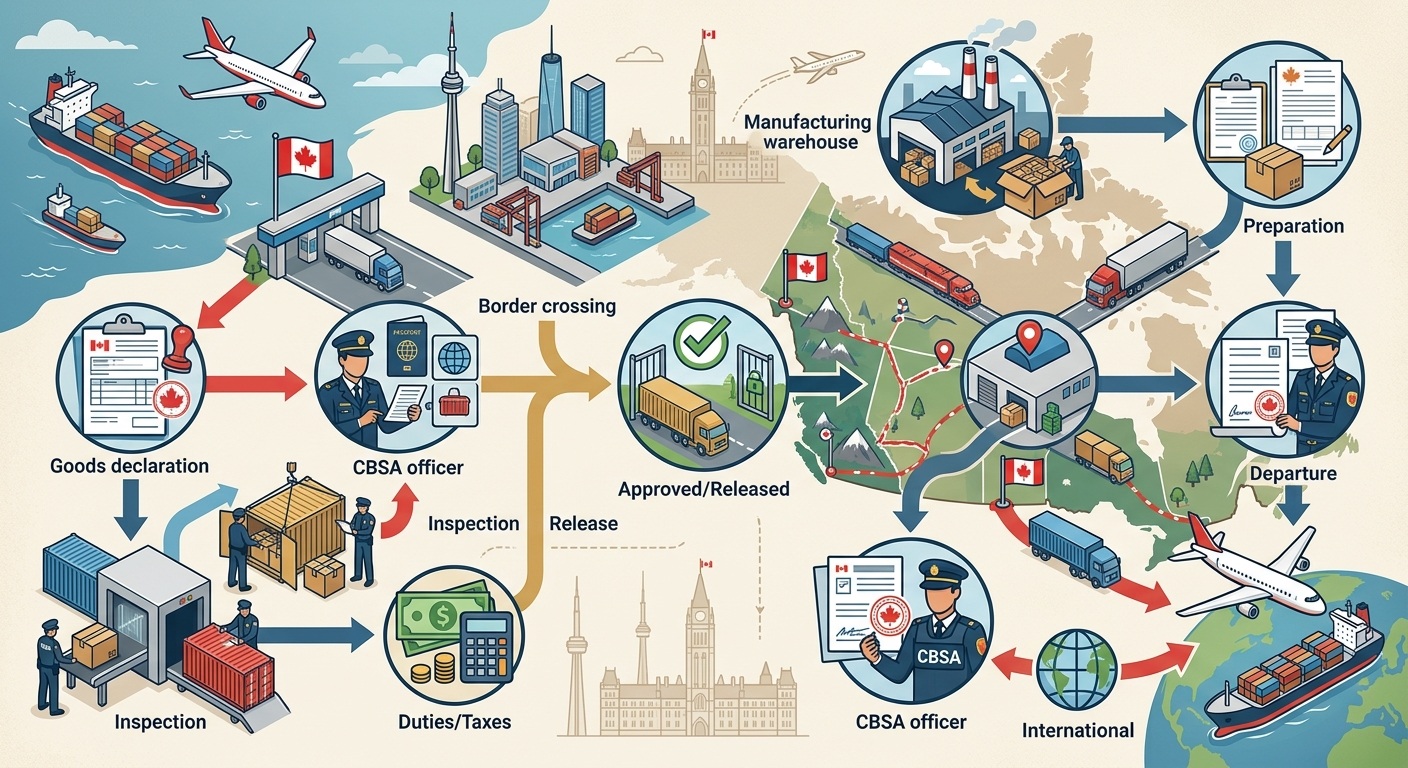
Customs clearance is an essential step when you import goods into Canada or export products to international markets. It involves submitting the required documents, declaring goods accurately, paying applicable duties and taxes, and meeting Canadian customs regulations.
Missing documents, incorrect tariff codes, or incomplete declarations can delay shipments and increase costs. Understanding the Canadian customs clearance process helps you prepare in advance, avoid unnecessary expenses, and keep your cargo moving smoothly.
1. What Is Customs Clearance in Canada?
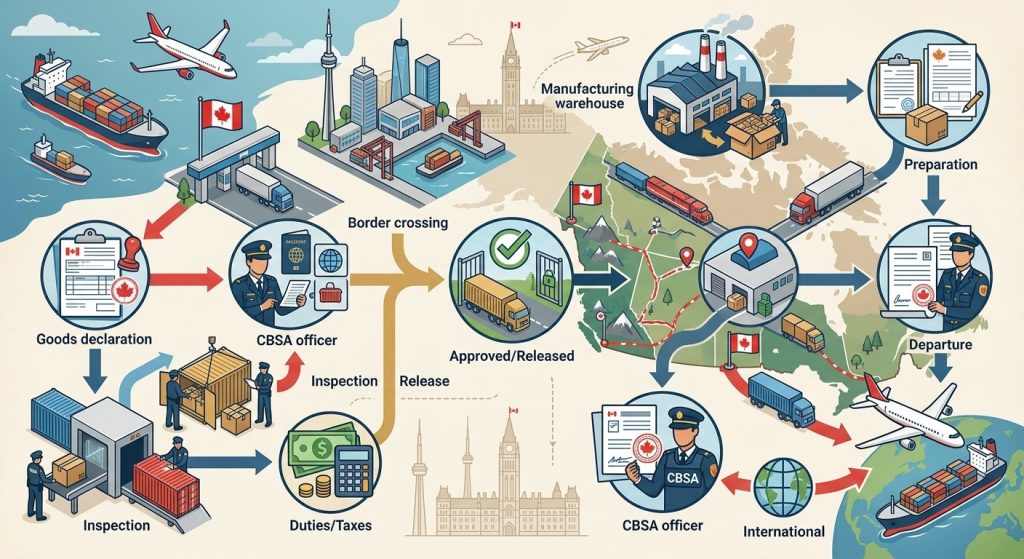
Canadian customs clearance is the process of declaring imported or exported goods to the Canada Border Services Agency (CBSA) and meeting the applicable requirements for their release or departure.
For imports, customs clearance generally involves verifying product classification, customs value, country of origin, and applicable duties and taxes. Certain goods may also require permits or approval from other government departments.
For exports, businesses must determine whether an export declaration, licence, or other authorization is required.
Who Is Responsible for Customs Clearance?
Several parties may be involved in the process:
- Importer: Ensures import requirements are met and applicable duties and taxes are paid.
- Exporter: Provides accurate shipment information and completes required export procedures.
- Customs broker: Prepares and submits customs declarations on behalf of an authorized client.
- Freight forwarder: Coordinates transportation, documentation, and communication between the parties.
- CBSA: Administers customs requirements, collects applicable duties and taxes, and examines shipments when necessary.
A customs broker can simplify the process, but the importer remains responsible for meeting its applicable legal obligations.
Import vs. Export Customs Clearance
| Item | Import | Export |
|---|---|---|
| Main purpose | Clear goods entering Canada | Meet requirements for goods leaving Canada |
| Key documents | Commercial invoice, packing list, transport document | Commercial invoice, packing list, transport document |
| Declaration | Import release and accounting information, as applicable | Export declaration when required |
| Main compliance concerns | Duties, taxes, classification, valuation, permits | Export reporting, licences, and restrictions |
The exact requirements depend on the goods, shipment value, destination, and transportation method.
2. Key Documents Required for Canadian Customs Clearance
Preparing the correct documents before shipment helps reduce delays and customs queries. The following are commonly required for commercial shipments.
2.1 Commercial Invoice
The commercial invoice identifies the goods and provides information used to assess their customs value. It generally includes:
- Exporter and importer details
- Product descriptions and quantities
- Unit prices, total value, and currency
- Country of origin
- Applicable HS codes, where available
- Shipping terms and relevant charges
Use clear product descriptions rather than vague terms such as “general merchandise.” The declared value must also comply with Canadian customs valuation rules.
2.2 Packing List
A packing list describes how the cargo is packed and helps customs officers verify the shipment. It typically includes package quantities, product details, gross and net weights, dimensions, and marks or numbers.
The information should match the commercial invoice and transport documents.
2.3 Bill of Lading or Air Waybill
A bill of lading is commonly used for ocean freight, while an air waybill accompanies air cargo. These documents identify the shipper, consignee, carrier, and shipment details.
Other transportation methods use their corresponding shipping documents or electronic cargo records.
2.4 Business Registration and CARM Account
Commercial importers generally need a Canada Revenue Agency (CRA) Business Number (BN) with an import-export program account, commonly identified by the RM extension.
The CBSA Assessment and Revenue Management (CARM) system manages commercial import duties and taxes. Importers should register in the CARM Client Portal and ensure that their customs broker has the appropriate authorization.
Financial security may also be required when goods are released before duties and taxes are paid. Check the applicable requirements before shipping.
2.5 Certificates of Origin and Other Permits
Origin documents may be needed to support preferential tariff treatment under a trade agreement. Eligibility depends on the applicable rules of origin, not simply the country from which the goods are shipped.
Certain products also require additional permits, licences, or regulatory approvals. These may apply to food, agricultural products, medical devices, chemicals, and controlled goods.
Check the relevant government requirements before dispatch to avoid delays after arrival.
3. How Does the Customs Clearance Process Work in Canada?
Although procedures vary by shipment type, most commercial imports follow several basic steps.
Step 1: Check Import Requirements
Before shipping, identify the correct tariff classification, country of origin, customs value, and applicable duty rate. Confirm whether the goods require permits, licences, or additional regulatory approvals.
Step 2: Prepare Shipping Documents
The supplier prepares the commercial invoice, packing list, and transport documents. You or your customs broker should check that product descriptions, quantities, values, and origin details are accurate and consistent.
For shipments from China to Canada, providing these documents to your broker before departure allows potential issues to be addressed early.
Step 3: Submit Cargo Information
The carrier or its authorized representative submits the required advance cargo information to the CBSA.
The importer or customs broker separately handles the applicable customs release and accounting requirements. Cargo reporting alone does not complete the importer’s customs obligations.
Step 4: Submit the Customs Declaration and Arrange Payment
The importer or authorized broker submits the required customs information, including the applicable classification, value, and origin details.
Customs duties and taxes are calculated according to the relevant rules. Your CARM account, payment arrangements, and any required financial security should be in order.
Step 5: Customs Review and Inspection
The CBSA may release the goods without a physical examination or request additional documents or an inspection. Other government departments may also review regulated products.
If further information is requested, respond promptly to help minimize delays and additional storage or handling costs.
Step 6: Obtain Customs Release
Once the applicable requirements are satisfied, the CBSA authorizes the goods to proceed.
However, customs release does not always mean the cargo is immediately available for pickup. Ocean shipments may still require terminal release, carrier payment, delivery order processing, and trucking arrangements.
Step 7: Arrange Delivery and Keep Records
After release, the freight forwarder or importer arranges delivery to the final destination.
Keep invoices, customs declarations, payment records, permits, and other supporting documents for the required retention period. Importers should also review their declarations and correct errors when necessary.
How Does Export Customs Clearance Work?
Canadian exports follow a different procedure. Exporters must first determine whether their goods require an export declaration or permit.
When required, export declarations are generally submitted through the Canadian Export Reporting System (CERS). Filing deadlines and exemptions depend on the shipment and applicable regulations.
The process typically involves:
- Confirming export reporting and licensing requirements.
- Preparing invoices, packing lists, and transport documents.
- Submitting the required export declaration.
- Obtaining any necessary permits or approvals.
- Coordinating cargo departure with the carrier.
- Retaining export records and supporting documents.
Not every shipment follows identical reporting rules, so the requirements should be checked before departure.
4. Customs Clearance Charges for Imports into Canada
The total cost of clearing goods in Canada may include customs duties, GST/HST, customs broker fees, inspection charges, and transportation-related expenses.
4.1 Customs Duties
Duty rates depend on the product’s tariff classification, country of origin, and applicable trade agreements or additional trade measures.
For example, goods manufactured in China and shipped through the United States generally remain Chinese-origin goods unless the relevant origin rules establish otherwise.
Check the current Canadian Customs Tariff to determine the rate applicable to your products.
4.2 GST/HST and Other Taxes
Most commercial imports are subject to federal GST, generally at 5%. The applicable tax base generally includes the value for tax purposes and customs duties.
Other taxes or levies may apply depending on the goods and circumstances. Eligible GST/HST-registered businesses may be able to claim input tax credits, subject to the applicable requirements.
4.3 Customs Broker Fees
Customs brokers charge for preparing declarations, reviewing documents, communicating with customs authorities, and coordinating release.
Fees vary by provider, shipment complexity, and the number of tariff lines. Additional charges may apply when permits, inspections, or document corrections are required.
4.4 Other Potential Charges
Depending on the shipment, you may also encounter:
- Carrier documentation and administrative fees
- Terminal and cargo handling charges
- Customs examination fees
- Storage, demurrage, or detention charges
- Warehouse handling and final delivery costs
These charges are not all government customs fees. Request an itemized quotation to understand which costs are included.
4.5 Example: Calculating Import Duties and Taxes
Assume you import commercial goods from China with a customs value of CAD 10,000.
| Item | Amount |
|---|---|
| Customs value | CAD 10,000 |
| Assumed duty rate | 6% |
| Customs duty | CAD 600 |
| GST at 5% on CAD 10,600 | CAD 530 |
| Total duties and GST | CAD 1,130 |
Calculation:
- Customs duty: CAD 10,000 × 6% = CAD 600
- GST: (CAD 10,000 + CAD 600) × 5% = CAD 530
- Total: CAD 600 + CAD 530 = CAD 1,130
This is a simplified example, not a quotation. The 6% duty rate is assumed for illustration; actual rates depend on the product classification, origin, and applicable tariff measures. Brokerage, inspection, terminal, and delivery charges are excluded.
5. Common Challenges with Canadian Customs Clearance
Several issues can delay clearance or increase import costs. Most can be reduced through accurate documentation and early preparation.
5.1 Incorrect HS Codes
An incorrect tariff classification may result in duty adjustments, additional reviews, or penalties.
How to avoid it: Provide detailed product information, including materials, function, and intended use. Verify the applicable Canadian tariff classification instead of relying solely on the supplier’s code.
5.2 Incorrect Customs Valuation
The declared value may be questioned if it does not comply with Canadian valuation rules. Certain royalties, assists, commissions, or other adjustments may affect the value for duty.
How to avoid it: Keep invoices, purchase orders, and payment records. Seek professional advice for related-party transactions or other complex valuation arrangements.
5.3 Missing or Inconsistent Documents
Differences between invoices, packing lists, transport documents, and declarations may trigger additional questions.
How to avoid it: Check that quantities, values, product descriptions, weights, and origin details match before shipment.
5.4 Missing Permits or Approvals
Regulated goods may require permits or approval before they can be released.
How to avoid it: Identify the relevant government department and confirm all product requirements before dispatch.
5.5 CARM Registration or Payment Problems
Incomplete importer registration, incorrect broker authorization, or missing financial security may complicate the release process.
How to avoid it: Set up your CARM account, verify broker access, and confirm payment and security arrangements before the cargo arrives.
5.6 Customs Inspections and Port Delays
Inspections, document requests, and terminal congestion can delay cargo release and increase storage or related charges.
How to avoid it: Submit accurate documents early, respond promptly to requests, and allow extra time for shipments requiring inspection.
5.7 Confusion Over DDP and DAP Responsibilities
Under DDP (Delivered Duty Paid), the seller generally assumes responsibility for import clearance and applicable import charges under the agreed Incoterms® rule. Under DAP (Delivered at Place), the buyer generally handles import clearance and import duties and taxes.
The actual arrangement must also comply with Canadian customs and tax requirements.
How to avoid it: Confirm who will act as importer, who will arrange clearance, and which duties, taxes, and service fees are included in the shipping quotation.
6. How to Make Customs Clearance Faster and Easier
You can reduce avoidable delays by preparing the shipment properly before it leaves the supplier’s warehouse.
- Check requirements early: Confirm tariff classification, origin, valuation, permits, and product restrictions.
- Prepare accurate documents: Ensure all shipping and customs records are complete and consistent.
- Set up your importer account: Verify CARM registration, broker authorization, and financial security requirements.
- Work with an experienced customs broker: Choose a provider familiar with your products and shipping route.
- Plan for possible delays: Allow additional time for inspections, permits, and terminal procedures.
- Calculate the full landed cost: Include duties, taxes, brokerage, handling, and delivery expenses.
- Keep complete records: Retain supporting documents and address declaration errors promptly.
7. Frequently Asked Questions About Canadian Customs Clearance
How long does customs clearance take in Canada?
Straightforward shipments with complete documentation may be released relatively quickly. Shipments requiring inspections, additional documents, or regulatory approvals can take several business days or longer. Terminal pickup and final delivery may require additional time.
Can you clear Canadian customs without a broker?
Eligible importers can handle their own customs procedures if they meet the applicable requirements and have the necessary account access and knowledge. A customs broker can simplify classification, declaration preparation, and communication with the CBSA, but the importer remains responsible for its obligations.
Do all imports into Canada pay customs duties?
No. Duty rates depend on tariff classification, origin, and applicable trade agreements or other measures. Some products have zero duty rates, although GST or other taxes may still apply.
What happens if customs holds your shipment?
The CBSA or another government department may request documents, inspect the goods, or require additional approvals. You or your broker should identify the reason for the hold and respond promptly. Storage and other charges may accumulate while the shipment is delayed.
Do exports from Canada require customs clearance?
Exporters must comply with applicable reporting, licensing, and export-control requirements. Some shipments require declarations through CERS, while exemptions may apply to others. Requirements depend on the goods, destination, and applicable regulations.
Who pays customs duties under DDP shipping?
Under a properly arranged DDP transaction, the seller generally bears the contractual responsibility for import clearance and applicable import charges. The parties must also ensure that the importer arrangements comply with Canadian law.
Conclusion
Canadian customs clearance depends on accurate documentation, correct tariff classification, proper valuation, and compliance with applicable regulations. Preparing these requirements in advance helps reduce delays and avoid unexpected costs.
If you are shipping goods from China to Canada, coordinate with your supplier, freight forwarder, customs broker, and Canadian consignee before departure. A clear division of responsibilities and an accurate landed-cost estimate can make the entire shipping process more predictable.