Container shipping companies play a key role in making global trade happen. They transport all kinds of goods across oceans, from electronics to daily essentials. By May 2025, this industry is expected to reach a value of USD 119.65 billion and continue to grow at about 3.11 percent each year until 2030. A handful of large companies shape trade routes, set freight prices, and help keep supply chains running smoothly worldwide.
For small businesses that want to start trading with other countries, the rules and processes of shipping can be very confusing. Still, knowing the big names in the business can help you see things more clearly. This piece details the Top 10 Global Container Shipping Companies by TEU Capacity. It highlights their market power and importance in facilitating global trade.
Global Trends in Container Shipping
United Nations data shows that about 80% of global trade moves by sea. Between 1983 and 2022, container trade volume increased by 7% each year. The Analytical Center of Sberbank of Russia reports that container shipping makes up 23% of dry bulk cargo trade and 16% of all goods moved.
Global Containerized Freight Volume (in million tons)

Upply reports that the Asia-Pacific region leads the global container shipping market, handling more than 70% of the world’s cargo. Most shipments stay within Asia, with the next largest flows going from Asia to North America and Europe. Container shipping is also growing quickly in the Middle East and Africa.
State of the Container Shipping Market in 2025
During the first three quarters of 2025, the global container shipping market found itself navigating choppy waters, battered by sluggish demand, sinking freight rates, and an oversupply of vessels. Drewry revealed that the World Container Index tumbled to $1,651 per 40-foot container, marking its lowest point since January 2024. Even as global container throughput soared to a record 16.61 million TEU in August, shipments from Asia to North America plunged 12.3% year-over-year, largely due to escalating US-China trade tensions and tariffs. At the same time, shipping companies launched an additional 2.3 million TEU of capacity in the first half of 2025. With total orders now reaching 9.6 million TEU—over 30% of the current fleet—the gap between supply and demand has become impossible to ignore.
Looking ahead to the fourth quarter of 2025, the market shows little sign of relief. Freight rates are poised to slide further as excess capacity continues to outweigh tepid demand. Persistent US-China trade disputes, including fresh port fees on rival ships, threaten to reshape trade routes and disrupt container flows. For shipping companies and cargo owners, staying alert and nimble will be crucial to weathering these turbulent times.
Top 10 Container Companies in the Shipping Industry
| Top 10 shipping container companies in the world | ||||
| Rank | Company | Total TEU | Fleet Capacity (Ships) | Headquarters |
| 1 | Mediterranean Shipping Company (MSC) | 6127485 | 861 | Geneva, Switzerland |
| 2 | Maersk | 4395066 | 716 | Copenhagen, Denmark |
| 3 | CMA CGM Group | 3793632 | 643 | Marseille, France |
| 4 | COSCO Shipping Lines | 3279936 | 508 | Shanghai, China |
| 5 | Hapag-Lloyd | 2249765 | 292 | Hamburg, Germany |
| 6 | Ocean Network Express (ONE) | 1938647 | 246 | Tokyo, Japan |
| 7 | Evergreen Marine Corporation | 1712161 | 220 | Taoyuan City, Taiwan |
| 8 | HMM Co., Ltd. | 879718 | 78 | Seoul, South Korea |
| 9 | ZIM Integrated Shipping Services | 753987 | 129 | Haifa, Israel |
| 10 | Yang Ming Marine Transport Corp. | 695078 | 93 | Keelung, Taiwan |
1. Mediterranean Shipping Company (MSC)

Mediterranean Shipping Company (MSC) is a privately owned global shipping and logistics leader. With a fleet of over 700 container vessels, MSC is committed to facilitating international trade between the world’s largest economies and emerging markets.
The company calls at 500 ports across 250 trade routes in 155 countries, transporting dry bulk and refrigerated cargo. Its annual cargo volume reaches 23 million TEUs.
Beyond maritime shipping, MSC provides multimodal services including door-to-door, factory-to-consumer, and combined transport solutions to fulfill delivery obligations for diverse cargoes.
2. MAERSK

Maersk Line is one of the world’s largest intercontinental shipping companies. Founded in 1904, it remains a leader in the maritime and logistics sectors. As of 2024, Maersk holds approximately 14.6% of the global container shipping market share, second only to Mediterranean Shipping Company (MSC).
Operating in 130 countries worldwide, Maersk transports goods valued at approximately $675 billion annually. Its fleet comprises five Maersk Triple E-class container vessels, each capable of carrying over 18,000 twenty-foot equivalent units (TEUs).
3. CMA CGM Group

CMA CGM is the world’s third-largest intercontinental shipping operator, accounting for 12.5% of the global container fleet. In the second quarter of 2024, CMA CGM transported 6 million TEUs, representing a 6.8% year-on-year increase. During the first quarter of 2024, cargo volume reached 5.6 million TEUs, marking an 11.7% year-on-year growth.
CMA CGM serves 420 ports worldwide with over 257 routes. Key destinations include:
- Asia – North Europe
- Mediterranean
- Red Sea
- Middle East
- North America
The CMA CGM fleet comprises over 623 vessels with a total capacity of 3 million TEUs.
4. COSCO Shipping Lines

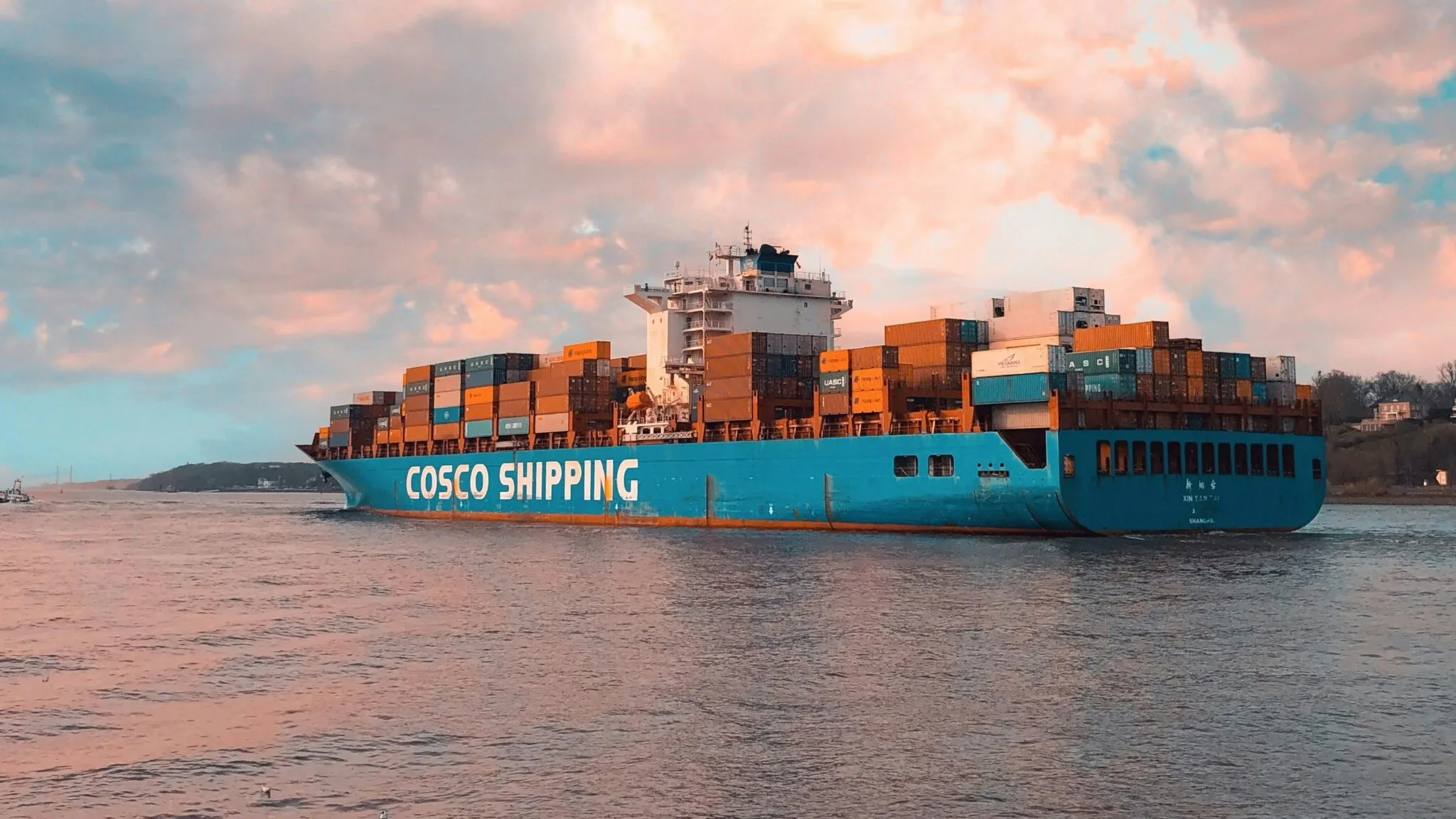
China COSCO Shipping Corporation Limited (formerly China Ocean Shipping Company) is one of the world’s largest shipping companies, formed by the merger of China COSCO Holdings and China Shipping Group in 2016.
Currently, the company provides a wide range of maritime services, including container shipping, bulk cargo shipping, tanker shipping, and specialized cargo shipping. It also manages container terminals and offers logistics services.
As of the end of 2023, the company operated a fleet of 1,417 vessels with a total carrying capacity of 116 million deadweight tons, making it the world’s largest shipping company by tonnage.
In the first quarter of 2024, COSCO Shipping Container Lines handled 6.0273 million TEUs, representing a 10.53% year-on-year increase. The company’s terminals achieved a total throughput of 33.2622 million TEUs.
5. Hapag-Lloyd

Hapag-Lloyd operates a fleet of 287 modern container vessels with a total container capacity of approximately 3.2 million TEUs. The company employs around 16,600 staff across more than 400 offices worldwide.
Hapag-Lloyd holds approximately 10% of the reefer transport market share, with a volume of 6.1 million TEUs in the first half of 2024, representing a 5% year-on-year increase.
6. Ocean Network Express (ONE)

One World Ocean Network (ONE) is a global container shipping company established in 2017 through the merger of three Japanese shipping lines: Kawasaki Kisen Kaisha, Mitsui O.S.K. Lines, and Nippon Yusen Kabushiki Kaisha. Headquartered in Singapore, the company maintains regional offices in Hong Kong, Singapore, the United Arab Emirates, the United Kingdom, the United States, and Brazil.
ONE ranks as the sixth-largest container shipping company globally by fleet size, holding approximately 7% market share. Its capacity is projected to exceed 1.8 million TEU (twenty-foot equivalent units) by 2024, positioning it among the world’s largest container shipping companies.
7. Evergreen Marine Line

Evergreen Marine Corporation is a major shipping and container company from Taiwan. The Evergreen Group also owns Yu-Rong Marine Co., Ltd., Evergreen UK Ltd., and Italian Maritime Ltd. Evergreen Marine is one of the largest carriers in the world by fleet size and cargo capacity.
The company’s main trade routes connect the Far East with North and South America, Northern Europe, the Eastern Mediterranean, and the Southern Hemisphere. It also operates key routes between Europe and the U.S. East Coast, as well as between Asia and the Middle East.
Serving 114 countries through 315 service centers, Evergreen Marine operates a fleet of more than 200 container vessels, calling at 240 ports worldwide.
8. Hyundai Merchant Marine Co (HMM)

Founded in 1976, HMM is the largest container shipping company in South Korea and ranks among the biggest worldwide. It offers transportation for containers, bulk cargo, and specialized shipments. HMM’s market share grew after Hanjin Shipping went bankrupt.
In 2024, Hyundai Merchant Marine plans to grow its fleet to 1 million TEU by adding 12 new container ships, each with a capacity of 13,000 TEU. This move aims to improve efficiency and lower costs.
9. ZIM Integrated Shipping Services Ltd

ZIM Integrated Shipping Services is Israel’s largest shipping company and has been a respected international carrier for more than 75 years. With headquarters in Haifa, Norfolk, and Hamburg, ZIM operates 200 offices and agencies in over 100 countries.
ZIM runs a modern fleet of 80 ships that visit 300 ports around the world. The company handles both dry bulk and refrigerated cargo, and its team offers creative solutions for shipping oversized, hazardous, and other special types of cargo.
10. Yang Ming Marine Transport Corp

Yang Ming Marine Transport Corporation delivers international shipping and logistics services. Its subsidiaries include Bright Shipping Co., Ltd., Smart Transport Co., Ltd., and E-Star Logistics Co., Ltd.
Building on this foundation, as of June 2022, Yang Ming Marine operates a fleet of 93 vessels with a total deadweight of 7.684 million tons and an operational capacity of 683,000 TEUs, primarily through container ships. Its freight operations span 70 countries and are conducted through 170 service points. The company further supports its global reach with logistics divisions and container terminals in Taiwan, Belgium, the Netherlands, and the United States.
Conclusion
By 2025, container logistics is expected to keep changing as it adjusts to new economic and geopolitical situations. While challenges remain, the industry is beginning to recover and shift its structure. Success will depend on using new technology, staying flexible, and reacting quickly to market changes.